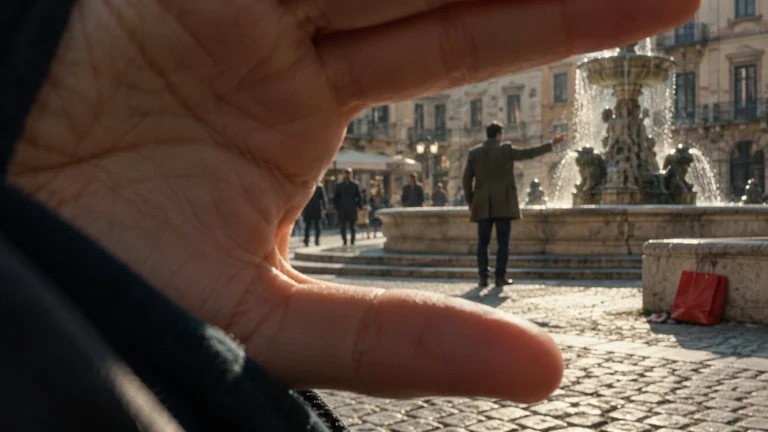
The man in the square seemed to be showing somebody a trick. He held one arm out and moved his elbow through the wrong side of the joint. There was no sound from his body, no change of expression. A woman beside the fountain dropped her shopping bag and did the same thing, except her elbow broke.
Tobin stopped walking. I was still telling him about a customer who had paid for a coffee entirely in small coins. The story remained in my mouth for a second after it had become useless.
"Don't stare," I said.
I meant it in the ordinary way. Somebody was having a bad afternoon and we should not turn it into entertainment. Then my elbow bent the wrong way, and I understood that I had been staring too.
Pain arrived after the movement. I held my injured arm against my chest. Around the fountain people were holding themselves in increasingly wrong positions. The first man leaned his head toward his shoulder and kept going. His neck lengthened as though the bones inside it had been replaced with rope.
Tobin made a surprised noise.
I shut my eyes.
The pressure in my elbow stopped increasing. It still hurt. The shape it had taken did not correct itself, but nothing new moved. I kept my eyes shut and felt for Tobin's coat with my good hand.
He was standing rigidly beside me.
"Close your eyes."
He asked me what I had said. His voice came from a lower place than it should have. I repeated the words, louder. He said he was trying to understand what was happening.
Somewhere nearby a man shouted for people to look at him. He might have been a rescuer. He might have been frightened and wanted help. I heard several sharp cracks follow his voice, then a sound like heavy fruit falling onto the pavement.
I pulled at Tobin's coat.
He fell against me. His weight came from an angle I could not prepare for, and we both went down. I kept my eyes shut even when my cheek struck the ground. The pavement was gritty and warm from the day. I could smell the sweet milk we had spilled onto my work shoes that morning.
Tobin asked whether I was hurt.
I told him my arm was hurt. It seemed important to answer the question he had actually asked. We had spent eleven years learning how to do that for one another, instead of turning every small difficulty into a contest over who had suffered more.
He said he was having trouble breathing.
I felt along his coat until I reached the familiar shape of a shoe. His foot was still in it. I held the shoe because it was a part of him I could identify without looking.
"Are your eyes closed?"
"Now."
The word came out thin and uncertain. He had watched the man's second movement. I knew it from the place his voice occupied, close to the ground and too far from the rest of his body.
I found my phone by feel. It took several attempts to make it place the emergency call. When someone answered, I gave the square's name and told her people were being injured by looking at another person. She asked whether there was a weapon.
"Tell them not to watch anyone's body," I said. "Cover them first. Tell them that."
She kept me speaking. I could hear people running, then stopping abruptly. Every few seconds another person called attention to something dreadful, and the square answered with more breaking.
Tobin said my name.
I moved closer along the pavement, holding his shoe with both hands now despite the pain. I wanted to put my face where I thought his face might be, but I was frightened of touching a shape that would tell me too much.
"Look at me," he said.
I told him I was there.
"Please. I can't feel where you are."
I pressed harder against his shoe. He said he could feel that. For a few breaths it seemed enough. Then he asked again. I had never refused him such a small thing. We had looked at one another across hospital waiting rooms, arguments, a restaurant table on the night he asked whether I still wanted the life we had made. Looking had always been the part I could manage.
I kept my eyes closed.
His foot moved once inside the shoe. I felt the movement against my palm and held it as if I could prevent it from ending. Afterward there was no response when I pressed.
The dispatcher asked me to describe his condition. I told her I couldn't look. I said it twice, then again when she asked whether he was breathing.
When someone finally reached us, I made them put a coat over him before I opened my eyes. I saw the shoe first. The laces were still tied in the loose double knot he used because he hated stopping to retie them. I stared at that while the rescuer spoke, keeping the last ordinary shape of him for as long as I could.