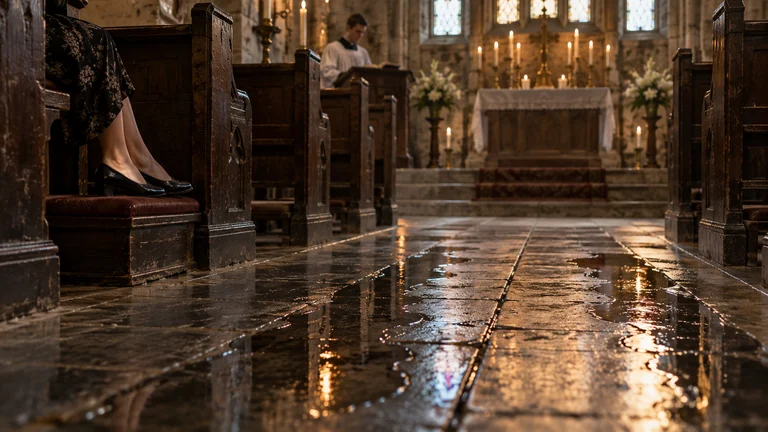
Dorian lost his place in the prayer because the woman beside him smelled of warm bread. For a moment he was back in his mother's kitchen, where he had once possessed a voice that could fill the room without hurting him. Then the others took their breath together, and something wet struck the chapel floor.
He looked down. Rainwater had gathered in the aisle, although the doors were shut and the afternoon outside was clear.
The new cantor raised one finger. He was a nervous young man in a borrowed robe. Before the memorial service he had explained that the pause after the second line belonged to the oldest form of the prayer. They were to leave room for those who could no longer answer.
Dorian had thought that rather beautiful. His wife had been among the names read out that morning. He wanted a service capable of making a little space for her.
The congregation completed the second line and drew breath.
Another wet sound came from the aisle, several pews nearer the altar. The water now lay in two long impressions, each tapering at the end. There were no toes. Dorian could see the pattern of the tiles through them, distorted as if under thick glass.
The woman smelling of bread lifted her shoes onto the kneeler.
"Is somebody coming in?" she whispered.
The cantor held his finger up again. He had seen the water. His eyes kept leaving the page, but he was determined to finish the prayer correctly.
Dorian tried to join the next line. The operation had left him enough voice for conversation, provided nobody interrupted. Singing made a dry place open in his throat. Halfway through the words he had to stop and inhale while everyone else was still speaking.
Something brushed the back of his neck.
He turned. The woman behind him was pressing herself into the corner of her pew. Her hat had flattened against her head, slowly, as though a large palm were testing its shape. The air above her smelled of a wet coat left too long in a cupboard.
Then the congregation paused together. Her hat sprang back. Farther down the aisle, the wood of a pew creaked beneath a weight nobody could see.
Dorian stood, catching his bad knee against the book rack.
"Stop saying it."
Several people turned with the weary indignation reserved for disturbances at funerals. The cantor faltered, then tried to steady them by beginning the second line again. He wanted to give everyone something familiar to do. Dorian could understand the impulse. He had spent the weeks after his wife's death washing cups that were already clean.
The next common breath brought the thing beside the front pew.
The woman seated there was pulled forward by her hair. Her husband caught her shoulders. The hair remained stretched upward, revealing a thin white strip of scalp. She made a small surprised noise and tried to raise one hand, politely, as if requesting permission to leave.
Dorian began singing the song his wife had hated.
It was a vulgar marching song with a verse about a bishop's trousers. He had learned it during a summer laying drains. His ruined voice scraped through the first line. People stared at him. Somebody laughed once in disbelief. The cantor opened his mouth to protest, and the scattered voices broke the next pause apart.
The woman's hair fell loose.
"Keep talking," Dorian said. "About anything. Don't wait for each other."
Her husband was already taking her toward the side door. A man shouted that there should be order. The baker-smelling woman shouted back that he could have all the order he wanted after they were outside. Their argument helped. People stumbled over prayers, complaints, the names of partners lost in the crowd. The wet impressions remained where they were.
The cantor tried to come down from the little platform. His lips were moving. He had put the book away, but the rhythm continued in his jaw.
Dorian caught his sleeve and pulled him toward the side door, talking about the chapel's terrible heating. He explained, in unnecessary detail, how his wife had once brought a hot-water bottle and pretended it was a handbag. The cantor's breath broke into a laugh that sounded painful. Behind them a pew splintered, though nobody was sitting on it.
Outside, Dorian asked people to spread out. The bereaved stood among the graves in awkward little groups, each speaking too loudly. Someone called an ambulance for the woman whose scalp was bleeding. Nobody suggested finishing the service.
The cantor sat on a stone border. He kept trying to apologize, then found himself halfway into the prayer. Dorian interrupted every time. They discussed bus routes and the cantor's rented room. They disagreed about whether the bakery opposite the station had changed owners.
Eventually the young man asked Dorian's wife's name.
Dorian told him. He began describing her, then had to stop. The silence arrived with all the things he had wanted to say inside the chapel. Beside him the cantor's shoulders rose for a breath, and Dorian seized his wrist before either of them could give the silence room.