You asked whether I still have the little curved needles. I have all of them, including the one you bent mending the swan. I am recording this with the phone beside my elbow. The scraping you can hear is the edge of the table against my sleeve. I cannot move it farther away.
The animal arrived in a crate marked UPPER COLLECTION. The heir had emptied his grandfather's storeroom before putting the house on the market. He wanted everything made presentable for sale, including the creature his family claimed to have discovered in a valley nobody could now locate on a map.
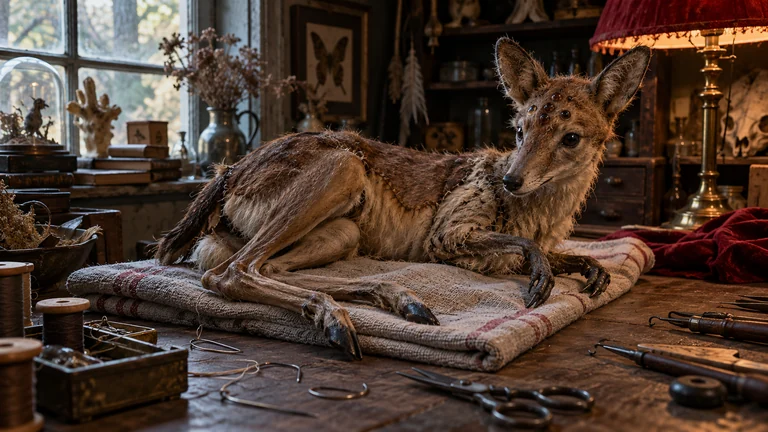
You would have recognized the fraud immediately. The hind legs belonged to a small deer, the forelegs to something that climbed. A narrow fox's skull had been fitted inside a larger skin. Its teeth did not meet. The tail came from a third or fourth animal, and somebody had glued three glass eyes along the forehead as though uncertainty about species could be settled by adding more eyes.
The oldest seam had opened beneath the ribs. I put a towel under it and began removing the brittle thread. Behind each stitch I removed, the edges drew closer. I mistook that for tension in the old hide. One foreleg had been attached backward. I turned it to see where the original joint would have sat.
The ribs moved aside to make room.
I thought I had disturbed the stuffing. That is what the mind gives you first, when it wants you to continue a familiar job. Then the leg bent in my hand. It placed its little paw against my wrist and held on.
I rang the heir. He asked whether the specimen would be ready by Thursday. When I said it was moving, he told me the collection had always been unusually valuable. His grandfather had refused offers from several museums. He thought this might explain why.
I told him to come immediately.
While I waited, the animal tried to sit up. Its rear legs pushed, but the shoulder structure was too low and the head struck the edge of the table. I caught it. The glass eyes remained glass. Behind the narrow jaw, something made a breath without finding an opening through which to release it.
I brought water in a shallow dish. It lowered its mismatched mouth and knocked the dish onto the floor. I cleaned up, brought another, and held it steady. The tongue was a dry piece of leather. It moved against the water with a frantic little scraping sound.
The heir watched this from the doorway. He was wearing the expensive expression people use when trying not to reveal how much they want a thing.
"It would need a secure case," he said.
I asked him to leave.
He did, after reminding me that the specimen belonged to the estate. There was no argument about whether it was alive. We could both see its chest moving. He simply found its movement more useful than I did.
By evening the animal had torn two of its seams attempting to turn around. It could not decide which legs to move first. Sometimes the back legs kicked while the front ones remained folded, and the head struck the table again. I padded the edge with towels. Each time it fell, the little climbing paw searched for me.
I thought about you repairing the swan's wing. You said the mistake was trying to give it a posture it had never possessed. This animal had never possessed any posture. Someone had assembled it for the pleasure of being believed.
I began taking it apart. I thought removing the supports would end what someone had made it endure.
The first cut opened the skin beneath the shoulder. Before I could lift it clear, small wet threads crossed the opening from inside. They tightened, drawing the edges together. The foreleg folded harder against the chest.
I cut the new seam. It closed more quickly. Each repair took a little more room away from the ribs. I could see the original thread caught beneath the new material, the earlier maker's error being pulled deeper into the body. The animal tried to raise its head and found that its chin had been drawn against its breast.
You would have told me to stop. I did stop, but the wet threads continued shortening. Its breath caught halfway out. The little climbing paw struck the table, twice, then lay against the edge with its toes open.
I made one more cut, under the jaw, where the oldest stitches had pulled the throat closed. Air passed the blade with a dry whistle. The chest moved. When I withdrew the blade, the cut began sealing itself before the next breath could enter.
That is where my hand is now. I am holding the opening with the small spreader and lifting the jaw with my thumb. A wooden wedge kept the edges apart but let the throat fold shut behind them. I have to change the angle whenever the chest rises. I can feel the new threads pulling against the metal.
The vet is coming. She asked me to describe what I could see and then said she would bring what she had. She did not promise anything. I liked her for that.
The heir is coming too. He called while I had the phone on speaker. I told him the animal could not be moved. He said his buyer was already on the way and that nothing must be done to alter the specimen's appearance.
Come to the workshop. There is a spare key beneath the empty planter. Please take the case off the front table before he arrives; he will assume anything inside it is ready to carry away. Then I need you here beside me, where you stood when we were mending the swan.
My thumb has gone numb. I cannot feel whether I am pressing too hard. Every time I try to ease it, the whistle stops, and I have to find the last place it was breathing.