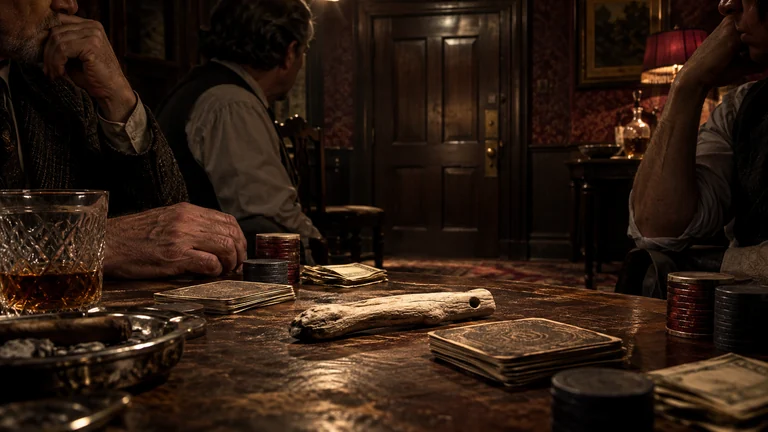
The old man put a piece of driftwood beside his cards. It was smooth and pale, with a little hole through one end. I told him we did not take objects as stakes. He asked whether that was my rule or the house's, and because I had been working for eleven hours I said it was mine.
"Then perhaps the house will be kinder."
He put banknotes beneath the wood, enough to cover the buy-in. I took the money and left the pale piece beside his cards, assuming it was something he carried for luck.
He lost the hand. Somebody knocked at the locked door.
Nobody was supposed to knock. The boardinghouse guests used a side entrance, and people coming to our game knew to telephone from the street. The room was above the old dining room, where the carpet still smelled of gravy when it rained.
The young man beside me, Jarek, stopped counting his chips.
"Who told her I was here?"
A woman outside called him by a shortened name he had not given us. She said his mother had been waiting since six. Jarek asked me not to open the door. I told him I had no intention of doing so.
The old man laid another pale piece of wood on the table. No one asked where the first had gone.
I could have stopped dealing. Instead I looked at the others. The woman opposite kept her cards raised; Jarek watched the door. If I accused the old man of cheating, I would have to say what he was doing. I gathered the cards.
At the next hand, the old man showed enough good cards to win and folded anyway.
A second voice joined the first. It belonged to a man who wanted to know whether the woman opposite me had ever collected the little blue bicycle. She pushed back her chair so hard that it struck the wall.
"My son sold that," she said.
"Who is it?" I asked.
She looked at the door and did not answer.
The old man smiled without showing teeth. He took the cards I dealt him and put them face down. From his coat pocket he produced a longer piece of wood, curved at the end like a finger.
I looked toward the window. The glass should have reflected our table over a view of the alley. Instead it showed a corridor with people standing along both walls. They were far away. Their heads were turned toward us, but their faces would not settle into features I could distinguish.
The woman opposite offered the old man all her chips if he would stop playing.
"I'm losing," he said. "You have nothing to complain about."
Jarek was speaking through the door now. He wanted to know whether someone named Pavel had come with the visitors. The voices fell silent for a moment. Then a young man answered.
Jarek made a sound I had heard once from a gambler whose entire wages had vanished in a single evening. He put both hands against the door.
"I went back," he said. "You weren't there."
The voice said he had waited as long as he could.
I could not remember the shape of Jarek's mouth. I was looking directly at him, but if I glanced away the face would not remain in my mind. I knew his jacket, the broken fastening on one cuff, the small burn on the table where he had put down his cigarette. His face was harder to retain than the faces in the window.
The old man began turning his cards over.
I pushed the table into him.
Chips and driftwood scattered. He caught the edge without standing, and for a moment I felt the table pushing back with more strength than his arms could contain. Then the legs folded. The cards slid across the floor in unfinished groups.
The voices stopped.
I unlocked the door. The ordinary hall was beyond it, narrow and badly lit, with the landlady's shopping trolley beside the stairs. I pushed people out before the old man could reach the fallen cards. Jarek stayed with his hands against the doorframe. He kept saying Pavel's name.
I pulled him down the stairs. Behind us, someone began knocking from inside the room we had just left.
On the pavement Jarek struck my mouth. He did it without warning and immediately began to cry. He said I had taken away the only chance he would ever have to explain himself.
"You don't know who was there," I told him.
"Neither do you."
He was right. I could remember the exact sound of every voice at that door. I could remember the old man's cough and the way the woman opposite held her cards. I could not remember any of their faces. Even Jarek's would not stay with me between one glance and the next.
I stood beside him while he cried, touching my bleeding lip. When he finally walked away, I followed for several steps because I was afraid I would not recognize him if he turned around.