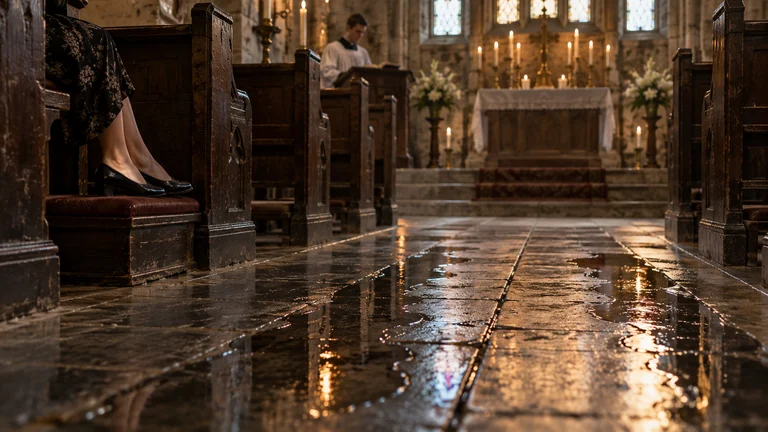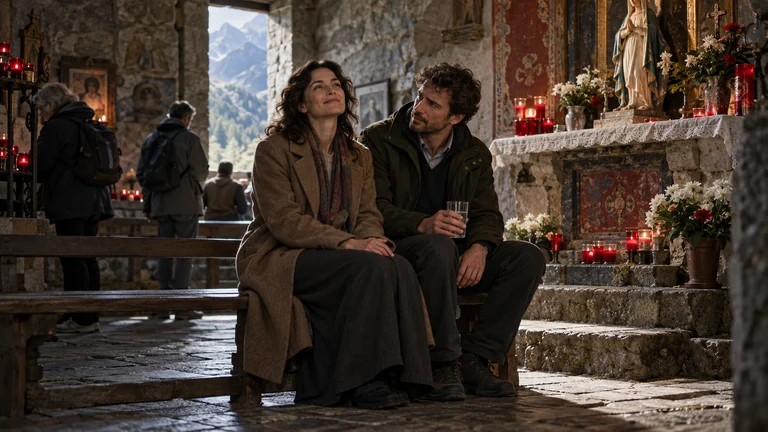
When the blessing reached Sabine, her feet lifted from the floor. She rose no higher than the depth of a hand, but everyone in the little shrine saw the daylight pass beneath her shoes. Her husband Tomas made a startled sound and moved toward her. The priest caught his sleeve, not to restrain him but because he too had lost his balance.
There was no voice. Nothing asked Sabine for a promise. The presence filled the space so completely that even the chipped corner of the altar seemed necessary and beautiful.
She came down gently.
Tomas began to cry. He had driven her three hours up the mountain because he loved her and she had asked, although he had made his feelings about miracles clear during the journey. Now he touched her arms, then her face, checking that the woman he knew was still there.
She kissed his wet cheek. She remembered every year they had shared. She loved him. The joy around those facts was so large that she could no longer find their edges.
The priest asked her to sit for a while. He brought water himself and stayed nearby without questioning her. Other pilgrims waited at a respectful distance. A woman with a crooked walking stick crossed herself and then sat down beside her friend, speaking so softly that Sabine could not hear the words.
She did not need to hear them. Everything in the room seemed complete.
After an hour, Tomas suggested returning to the car. The path down from the shrine crossed rough stone steps and a narrow stretch of gravel. He offered his arm, although it was usually she who steadied him on uneven ground. She took it and laughed at the reversal. He laughed too, relieved to find a familiar joke inside what had happened.
At the steepest bend his foot slipped between two rocks.
He fell heavily, pulling his arm from hers so she would not go down with him. The sound from his ankle was clear. Sabine heard it and understood exactly what it meant. She had worked in a shop where a colleague once fell from a ladder; she remembered the shock, the awkward angle, the urgent search for a telephone.
Tomas tried to sit up. His face changed with the pain.
The change was beautiful.
Sabine knelt beside him. She stroked the damp hair from his forehead and told him she was there. He breathed through his teeth, looking down at the foot he could no longer place properly.
"Call someone," he said.
She took out her phone. Her hands knew what to do. She gave the location to the person who answered and explained that her husband had fallen on the shrine path. The dispatcher asked questions quickly. Sabine answered them, then listened to instructions about keeping Tomas still while help came.
The urgency entered her joy like a loud voice entering a room where someone was sleeping.
She ended the call.
Tomas looked at the phone, then at her.
"What did they say?"
"They wanted us to hurry."
"They wanted you to hurry?"
She could hear how difficult it was for him to speak. Each breath required a new decision. She loved him for making them. She wanted him to know that she could see all the effort of his body, the sweat beneath his collar, the little movements of his hands seeking somewhere safe to put their weight.
She told him this.
He asked her to call back.
For a moment she tried to remember the feeling that would make his request urgent. She could remember having felt it. She could recall the day he cut himself repairing a window and the ordinary terror of seeing his blood. The memory remained clear, but its terror had become another perfect thing among the others.
"You don't have to change it yet," she said.
Tomas pulled his hand away.
A pilgrim coming down the steps found them. He was carrying a paper bag of devotional cards and stopped immediately when he saw the angle of Tomas's foot. Sabine told him what had happened, including the call. The man looked at her with anger she recognized and could no longer share.
He called for help again and stayed with Tomas. When Sabine began describing the blessing, he asked her to be quiet. She obeyed readily. His fear and anger seemed as rightful as the sunlight moving over the rocks.
The rescuers arrived while the shrine bell was sounding. They spoke to Tomas, gave him practical things to attend to and prepared to move him. Sabine stepped aside whenever they asked. She was pleased that so many people wanted to help the man she loved.
As they lifted him, she reached for his hand.
Tomas drew it against his chest. He looked at her as though she had remained on the shrine floor while somebody else came down the path wearing her face. Sabine understood the comparison without being able to feel insulted by it.
She walked behind the stretcher, carrying his jacket. Once he looked back to make sure she was following. The fear in his face filled her with such tenderness that she smiled, and he turned away before she could tell him how much she loved him.