They told me on Monday that I would be moved to the lower cells on Wednesday. Nobody came back from there. That does not mean everyone died. Some remained for years, and I think the distinction matters more to the people below than to those making the arrangements above them.
The man in the next cell heard the announcement. After the guards left, he asked whether I had ever thought about leaving my bones behind.
I told him I had tried leaving everything else.
He laughed. It was the first time I had heard him laugh. We had shared a wall for nine months and knew one another mainly through practical exchanges: footsteps in the corridor, the time since meals, whether the water was running clear.
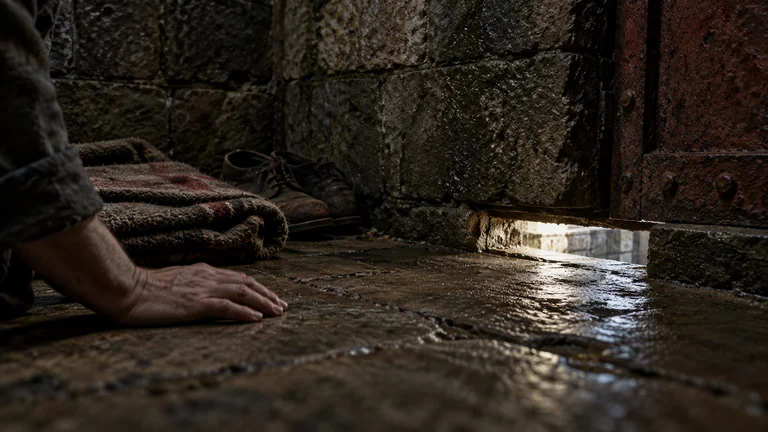
He said the wall contained a way out. The ventilation gap beside the floor went through the outer foundation, although a turn inside it prevented anyone seeing daylight. It was wide enough for an arm and very little else.
"You only have to make the rest of you like the arm," he said.
I asked whether he had done it.
After a long silence he said that getting out and being put together were different things.
I will not pretend I can teach you what he told me. In the cell, with the light off, his words gave my body an arrangement it had never possessed. In daylight I could remember them only as an impossible series of directions. They did not describe cutting. My skin stayed whole. It was more like finding that the lining of a coat had always contained an opening somebody forgot to sew.
The first bone lay on the blanket while I still felt it inside my hand. It was white and slightly damp. My finger bent without it, soft at a place that had never been soft before.
I pushed the finger into the ventilation gap. It passed around the hidden turn without resistance.
I sat on the floor until breakfast arrived, keeping the hand under my shirt. The guard said I looked ill. I asked whether the move had been cancelled. He said I should eat while I still had an appetite.
I waited until the footsteps had gone, then asked the man next door what happened if I changed my mind.
He said he did not know how to make a bone belong again.
By evening I had decided.
There were things I wanted outside the prison that had nothing to do with standing upright. I wanted someone to use my name without consulting a list. I wanted a window I could approach whenever I chose. I wanted to hear a conversation I was not required to understand. These were small desires compared with the body I would have to take apart, but I had spent years learning how large a small desire could become.
The work was quiet. That frightened me more than pain would have. The bones came free in an order I could not have explained to a person who had only lived inside an ordinary body. I remained awake. I remained myself. When I tried to laugh at the heap beside me, the sound came from a chest that no longer held its shape.
The skull had come apart into narrow petals. I knew that skulls did not do that. The cell had given it joints that were not there before.
I put the bones through the gap first. I did not want to leave any part of myself for the guards to find and call an explanation.
Then I followed.
The turn inside the wall was rough. I felt every grain of grit against skin that had lost the support beneath it. At one point I stopped moving and believed I had made a terrible mistake. Then cold air touched my face, and I wanted it enough to continue.
Outside was a strip of ground between the prison wall and a disused loading road. Rain had fallen earlier. The bones lay scattered in the wet grass, visible in the light from a distant building. I had imagined gathering them, arranging them, finding some gesture that would reverse what the cell had permitted.
I could not lift my head.
I tried for a long time. I could move, but movement no longer led naturally to another position. A knee had been a place to put weight; now there was only living softness and the memory of where the weight should go.
At dawn a woman walking to work found me. She screamed, then stayed. I was grateful for both responses. She put her coat beneath the part of me she understood as my head and called for help.
I told her the white pieces in the grass belonged to me. She looked toward the prison, then back at my face.
"Did they do this?"
I said I had done it to get out. She asked whether I wanted her to tell the people coming. I said yes, provided she also told them I was not going back through the wall.
She stayed beside me, holding the coat so the wet ground could not reach my mouth. Beyond her shoulder I could see the sky without a grille across it. When she asked my name, I had enough breath left to give her the whole of it.