Yara sold the lamps as lamps. This cost her business because the stall opposite sold exactly the same devices as pieces of distant stars.
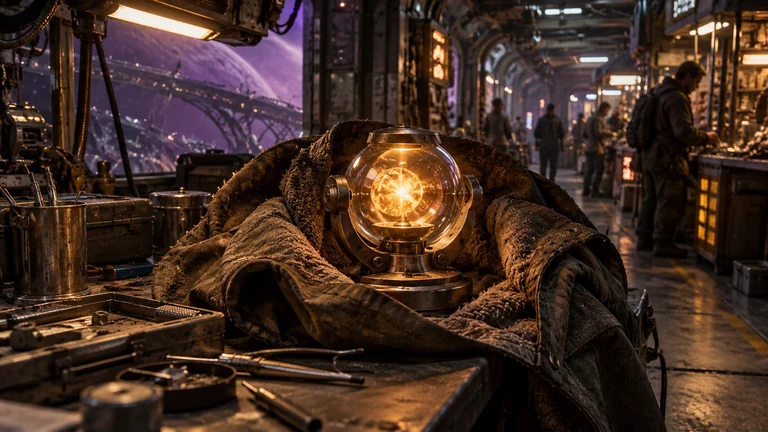
Each contained a manufactured fusion cell in a magnetic cradle. A sealed window made its tiny plasma look larger than it was. Customers could select a color, a brightness and a slow variation that resembled the flares they had seen in astronomical recordings. Yara wrote the cell's operating life on the receipt. Her competitor supplied a certificate of celestial origin.
When people asked why her lamps were cheaper, she said where they were made. Some looked relieved. Others crossed the passage to spend more money.
The ship had been traveling for twelve years. A person could become attached to an expensive misunderstanding in less time than that.
The fuel notice appeared during the morning market. A leak had contaminated the reserve of rare ignition fuel used to start the maneuvering engines. The ship had ample reaction mass and power; what it lacked was enough clean starter charge to make all the planned corrections on approach. Hundreds of ornamental cells contained small quantities of a compatible isotope mixture.
They did not need the stars to push the ship. They needed the fuel inside them to begin a burn.
Yara read the engineering sheet before agreeing to surrender her stock. The collection would restore a limited reserve, not make them safe forever. The return credit was less than retail price but more than she had paid wholesale. She could live with that.
Then Noll came to her stall carrying a lamp wrapped in his own coat.
He had bought it opposite six years earlier. Its certificate identified the home star of the world he had left. He had shown Yara the document several times, usually when he needed a minor repair and wanted her to understand why extra care mattered.
She had replaced its switch. She had cleaned its window. She had never told him what she thought of the certificate because he had not asked and because repair customers returned even when lamp customers did not.
"They say the originals are exempt," he said.
There was no exemption in the notice.
"Who says?"
He looked toward the other stall. Its shutter was down. The proprietor had gone to the collection office to negotiate compensation for the remaining stock.
Noll unwrapped the lamp. Its light was warm orange, with a programmed flare that brightened every forty-seven seconds. The pattern came from a demonstration recording included with the factory firmware. Yara had watched technicians select it hundreds of times.
"This one can't be replaced," he said.
She opened a box beneath the counter and took out an unlit lamp of the same model. She showed him the serial plate, the fuel cartridge and the menu of stored flare patterns. Then she selected his pattern on a test unit, put the two beside each other and restarted both cycles together.
Their light rose together.
Noll asked whether her lamp had been copied from his.
"They were both made from the same design."
He took out the certificate. She read the small print aloud, including the phrase representative stellar material. The manufacturer had supplied an ordinary device. The dealer's additional claim appeared in a separate sentence with no supporting record.
"You knew."
Yara could have distinguished suspicion from proof. She could have explained how little a repair charge entitled her to know about a customer's private consolations. She had used both distinctions while replacing his switch.
"I knew what the lamp was," she said.
He kept it on the counter until its next flare. Then he switched it off himself.
At the collection office, an engineer explained how the cartridges would be opened and their fuel recovered. Noll asked for the empty casing back. The engineer agreed, then paused when Noll asked whether the reserve would be enough if another correction failed.
"It gives us another attempt," she said. "We still have to make it work."
Noll looked at Yara, who had come to help carry the stock. He asked the engineer to say that again while he recorded it for the market association.
The engineer repeated the figures slowly enough for him to capture them.
The recovery team needed people to sort cartridges by type. Noll had repaired small heating equipment before he came aboard. He volunteered for two shifts, then stayed for a third. The expensive lamps were no harder to open than the cheap ones. Their certificates accumulated in a paper bin beside the workbench.
Yara helped him remove a cartridge whose cradle had warped. He handled it carefully even though the lamp's certificate named a star he had never seen and a dealer whose claims he no longer believed.
His empty casing came back in a transparent bag. The window still held the reflection of the workshop lamps. He asked Yara whether she wanted it for spare parts.
"Are you sure?"
"You fixed the switch. Someone might need it."
She put it on the salvage shelf, with its actual model number and manufacture date. Noll returned to the bench, where the next cartridge had a stripped fastener. He asked for a smaller driver and felt its tip catch against one edge of the worn head.