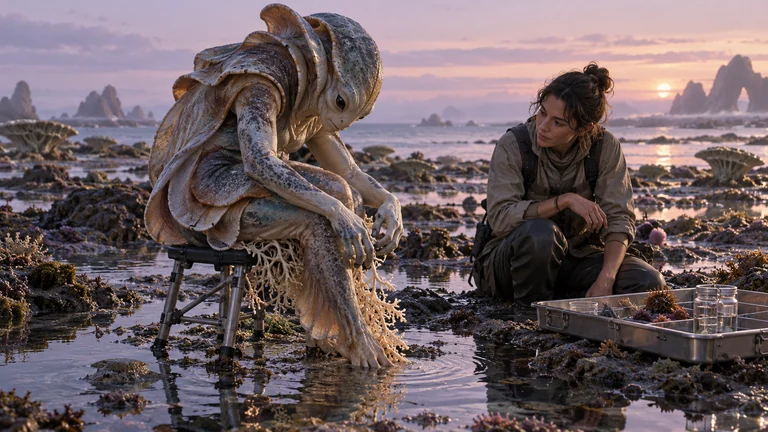
Aru's anchoring growth caught on the field stool. Ro heard the little scrape and looked down. A pale branching structure had emerged beneath the lowest fold of their body, narrow enough to resemble a loose thread until it contracted away from the metal.
"Already?" she asked.
Aru lifted the stool free. "It has been already for some time."
They went on sorting the sediment samples. Ro tried not to watch the place where the growth had withdrawn.
For seven years she and Aru had traveled the tidal margins, mapping changes around the nurseries. Aru could taste a shift in the water's mineral balance before Ro's instruments registered it. They were also impatient with her filing habits, excellent at finding dry shelter and unwilling to forgive a joke after it ceased to be funny. Ro had come to think of those qualities as what Aru would always be.
Their people did not remain mobile throughout adulthood. At the anchoring season, they settled in the tidal nurseries and grew a larger body distributed through the reef. The senses that made Aru a good field researcher developed into something a walking companion could only sample through instruments. Their social life expanded with them. They did not regard this as retirement.
The human mission did.
The promotion offer arrived with a congratulatory recording. Aru would lead the next survey voyage, the first nonhuman to hold the position. The ship would depart before the anchoring tide and return two local years later. The medical support package included another cycle of developmental suppression.
Aru played the recording three times.
Ro asked whether they had spoken to the nursery physician.
"I know what you will say."
"Then you can tell me what they said."
Repeated suppression could cause the anchoring structures to atrophy. The previous cycle had already narrowed Aru's options. Another would almost certainly end them. The field physician could keep their mobile body healthy for years, but could not promise to restore the organs required for the reef.
Ro had assumed that fact settled the matter.
Aru showed her the position description. They would set the sampling priorities, choose the landing sites and stop having to persuade a human supervisor that a change in the water deserved attention. Their name would appear above Ro's on the reports.
"I want this," they said.
It was sufficiently plain that Ro could not mistake it for confusion.
She contacted the mission director about a delayed departure. He said the orbit window was fixed. She asked whether leadership could continue from a nursery, using remote instruments and local crew. The position required physical presence in changing environments. That was true of the job they had designed. She could not persuade him to consider designing another one.
Aru asked her to stop making calls on their behalf.
They spent the week before departure closing the field camp. Relatives still in their mobile phase came to visit, settling in the shallows while Aru stood on the bank. Ro heard only the translated portions of their conversation. There was argument, irritation and one exchange that made Aru laugh so hard the new growth brushed the water.
Later they asked Ro to accompany them to the clinic.
The physician explained the procedure and alternatives again. Aru listened without impatience. Ro waited outside during the intervention, staring at a wall display that showed the mission's planned route. She knew which estuary should have been included and which redundant stop ought to have been removed. Aru would be able to change those things now.
They came out with the anchoring tissue gone.
On the ship, Aru was a demanding chief. They rejected poor samples, insisted on extra observation time and once diverted a landing to a site Ro would have dismissed. The decision revealed a chemical exchange nobody had recorded before. Their colleagues respected them. Ro respected them too. It would have been easier if the promotion had turned out to be a fraud.
When they returned, the nursery cohort had grown through two seasons of tides. Former companions occupied ridges and channels, their bodies difficult for Ro to distinguish from the living structures around them. Visitors laid sensory plates in the water to converse at the reef's preferred speed.
Aru brought their own plate. They had always understood the nursery signals partly through their remaining developmental senses. This time the plate showed activity they could not feel.
They adjusted its position. Ro checked the connection.
"It is working," she said.
Aru waited through another exchange. Their relatives were discussing a change far along the current, something the anchored bodies experienced across the whole nursery. The translation offered a spatial model. Aru enlarged it, trying to find the local sensation it should correspond to.
There was none.
They asked Ro to describe the instrument reading. She did, carefully, as she would for a human visitor arriving without any of the relevant senses.
The conversation continued around the plate. Aru had news of the voyage, a discovery, plans for the next expedition. They entered all of it. The nursery responded with interest. Nobody excluded them.
After a while Aru asked whether the plate could be made faster.
Ro knew the answer. She had explained the nursery interface to visitors for seven years. This time she put the controls in Aru's hands and stayed beside them while they searched through settings that had never been designed to replace what was missing.