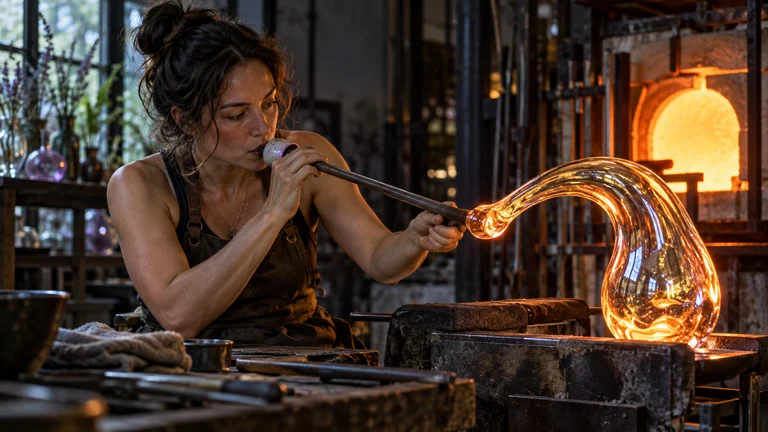
Jem held her breath in the wrong places. I told her that the first week, and she said she knew. She had learned with a damaged lung. What looked like hesitation was how she got enough air to finish a piece.
I did not employ her out of kindness. She was good at catching faults while the glass was still soft, and she arrived before the furnace reached temperature. My previous assistant had treated the furnace as a colleague who could wait for him.
By then I was making most of my living from other people's mouths. The assisted blowing head fitted to a standard pipe. Its valves shaped a user's pressure according to a licensed pattern, while a vibrating collar prompted the next breath. My name was on three patterns. A competent glassworker still had to gather, turn and heat the glass, but they could make my long-necked bottles without spending five years learning where the neck would collapse.
I received a little money each time somebody selected me.
Jem used an unassisted pipe whenever she could. The collar kept telling her to breathe when her lung was not ready. I offered to turn down the prompts. She said she would rather have the machine wait.
The commission that changed things was a pair of lamps with an unsupported bend, like a person leaning to hear a confidence. I had drawn them too beautifully. At working temperature the inner wall of the bend kept folding into a crease. Reheating it enough to repair the crease spoiled the outer curve.
I broke four before Jem asked whether she could try.
She alternated short pulses with a held pressure I had never thought to use. During the pauses she rotated the pipe a little, letting the glass settle against the air. The curve grew unevenly and then corrected itself as it cooled.
I remember being annoyed before I was impressed.
She held it up to the inspection light. There was no crease. A faint spiral ran through the thickness, visible only when she turned it.
"Again," I said.
She made another. The second was better.
I said we should record the pressure trace so we could understand what was happening. There was nothing wrong with that. We recorded everything difficult. A mouthpiece in diagnostic mode measured pressure without controlling the valves, and she agreed to use it.
The trace looked untidy beside mine. It was full of small recoveries. A customer would never select it if we showed them the raw line.
I spent the evening fitting the trace to the trainer. It needed temperature limits and a rotation prompt; breath alone does not make glass, whatever the advertisements imply. I was still working when the licensing representative called about my renewal. My old patterns had fallen below the minimum use threshold. He said he was sorry, but the platform preferred a smaller catalogue of active makers.
I told him I had something new.
Jem had no registered profile. Creating one would require an assessment fee, a separate contract and a delay. My name was already there, with a little mark that meant verified.
I put the trace under it.
The next morning I demonstrated the assisted head to Jem. The finished bend was not quite as fine as hers, but it was repeatable by somebody who knew what they were doing. Her face changed when the collar prompted my first pause.
"You put it on the market."
"I've submitted it for review."
"Under your name."
I explained the account problem. Then I explained the temperature calibration, the hours of work I had done and the fact that the commission belonged to the workshop. Each explanation was true. I used all of them.
She asked me to withdraw it.
By then there were trial activations from twelve countries. The renewal had been approved. I had ordered a replacement furnace door we needed and paid the deposit from the advance.
"We can put you in the development notes."
She took the diagnostic mouthpiece apart and cleaned it. That frightened me more than if she had broken it. She laid each piece on a cloth, dried the pipe and returned it to the rack. Then she asked for her wages through the end of the week.
I paid them. I added a bonus. She left the transfer terminal showing the amount and did not thank me.
At the demonstration, a journalist asked what had led me toward a less symmetrical form. I said age had made me more willing to accept irregularity. It was an answer I could have given before any of this happened, and perhaps for that reason it came easily.
The collar vibrated against my lip. I paused. Across the little ring of observers, someone nodded as if they could see the decision passing through me.
The glass bent and held.
Afterward the licensing representative suggested naming the pattern Late Breath. He said it would connect the new work to my age without sounding mournful. I approved it.
On the train home I watched a customer demonstration on my phone. A young man in another workshop followed Jem's pauses, carefully, exactly, while my name remained below his hands. At the difficult bend he stopped long enough that I thought he had lost the rhythm.
Then he drew breath where she would have drawn it, and the piece survived.