Sula bought the ring by weight, which was the first mistake. On the scale it weighed fourteen kilograms. Lifted three centimeters above the scale, it weighed enough to drag her shoulder out of its socket.
She let it fall. The floor dented.
The scrap dealer said the scale was certified. She said nothing about the floor. He had already transferred the lot out of his inventory, and she had already accepted it.
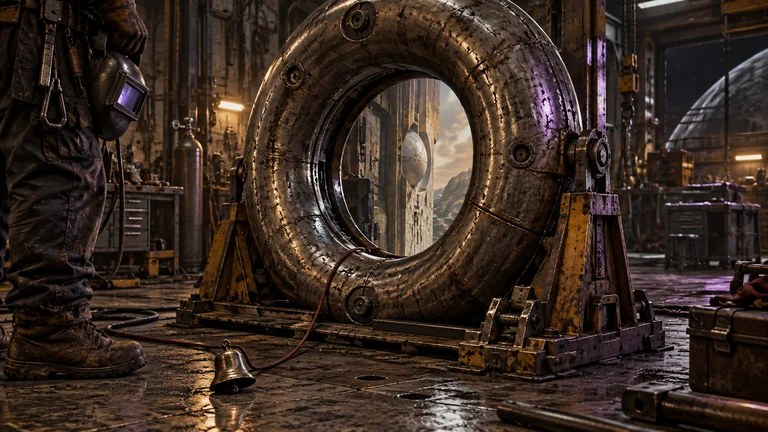
The ring was wide enough for a person to crawl through. Its outer surface looked like dull metal, but the inner edge had a depth her eyes could not settle on. Looking through it showed the bay from one angle and a narrow strip of unfamiliar wall from another. Sula put a welding rod through the strip. Its tip struck something three hundred millimeters beyond where empty air should have been.
When she moved the ring, the wall moved with it.
She called a survey physicist she knew, who called somebody more expensive. They explained that the object anchored one mouth of a spatial link. Its other end was physically constrained, so moving this end pulled against whatever held the far end. The scale had measured only the ring while it rested at the link's slack position. Beyond that slack, Sula had been trying to lift something else.
They would not say what.
A buyer arrived before the survey invoice. He wanted the boundary material, which was worth more than her entire bay. He would take responsibility for severing the link and would pay extra if she could keep other bidders out until his equipment came.
Sula asked what happened at the far end when it was cut.
"The connection ends."
"I meant what happens to the thing attached."
He said they could not assess an inaccessible structure. She noticed that inaccessible had become the word for somewhere they had not yet tried to enter.
That evening a cord came through the opening. It slid across the bay floor until the end reached her boot. Someone had tied a small metal bell to it. The bell rang once, then twice.
Sula pulled twice.
A bundle followed, pushed through the throat of the ring. It contained a folded fabric panel, three cups and something that might have been a lamp. She had paid for scrap before and found valuables inside. She had never found somebody actively packing.
She secured the ring to her welding frame. The frame was bolted to a bay anchorage rated for ordinary salvage loads, and she added a second restraint to the crane rail. She told the buyer to delay the cutting crew.
He came himself.
By then six bundles lay on the floor. Sula had pushed a camera through on a rod. Its image showed a corridor listing at an angle, water crossing the floor in shallow waves, and the other ring fixed to a structure that was slowly bending.
"An evacuation," she said.
"It could be abandoned machinery moving cargo."
A hand came through.
It had four broad fingers and pale pads along the joints. Sula took it before she had time to decide what the gesture might mean. The fingers closed around her wrist and guided it toward a fabric harness. Somebody was asking for help with a load.
The first traveler crawled out, dragging a second in the harness. They were small and wide, with folds that opened along their sides when they breathed. The ambulant one touched the ring, then the floor, then pointed at the ceiling as if looking for something that ought to be holding it all up.
The bay anchorage tore free.
Sula saw the bolt heads lift together. The far structure had moved, pulling through the rigid link and consuming the slack she had allowed. The crane restraint caught the frame before it could roll over the travelers. Its load indicator went into a range she had never needed.
She lowered the crane boom to give them a little more travel and shouted at the buyer to move the bundles. He obeyed, dropping his case to use both hands.
The traveler found her welding controls. Sula stopped its hand, showed the power switch and waited. It opened one of its bundles and produced a flexible lattice that hardened when stretched. Together they braced the frame to two bay ribs. Two more passengers crawled through while they worked, leaving wet tracks across the floor. Then the first traveler went back through the ring.
On the camera, Sula saw it join a fifth passenger beside the damaged mounting. They bent together over a cutting implement. A brief bright flicker filled the image. The load fell as the mounting was cut away. The distant mouth floated free in the damaged corridor, no longer tied to its failing structure. The first traveler returned and took hold of the harness. The last traveler came through and caught the local frame.
There were five of them in the bay. One could not walk. The buyer sat beside that one, holding a cup without knowing how to offer it.
Over the following days, translators made their requests less approximate. They were passengers from a wrecked transport. The ring belonged to their emergency passage system; one mouth had been lost with a jettisoned compartment and collected as debris.
They wanted it back.
Sula showed them the purchase record. Their translator took time over it. Then they showed her the transport's passenger list and the maintenance record of the ring.
She looked at the repaired ribs of her bay. Their lattice work was worth more than the purchase price of the ring.
In the end she billed them for the welding time and asked to learn the repair. They paid in materials. The crane lowered the frame and ring into their transport cradle. Sula watched them strap it down, then returned to the welding bench to examine the lattice they had left in payment.