The paint beneath the signature was still soft.
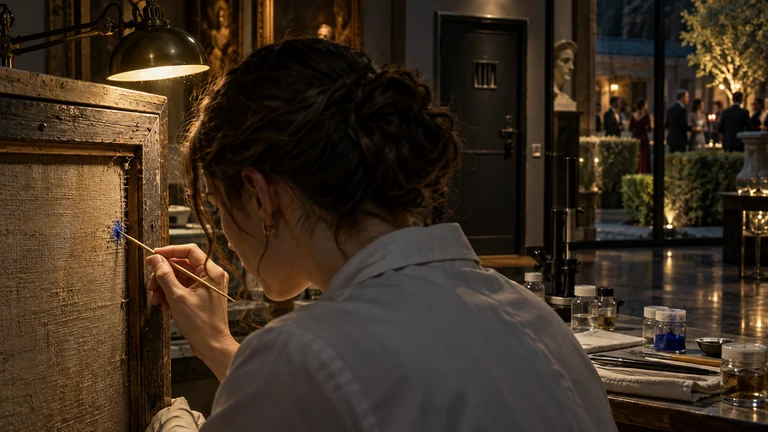
Luz found it while examining the canvas before it went on loan. A small bead of blue had worked through the weave and adhered to the lining. She touched the edge with a wooden probe, then looked again at the date on the label.
Orrin Beck had drowned twelve years earlier.
His dealer, Caspar, watched her from the doorway.
"Problem?"
"Someone's worked on this recently."
"Conservation."
"From the front. Beneath the signature."
Caspar came into the room and closed the door. He laid a printed condition report beside her tools. Every box had already been checked.
"You're very good," he said. "That's why I hired you."
Beyond the courtyard, guests were arriving for the private sale. The painting was the centerpiece: an undiscovered work from the artist's last summer. Luz had spent the afternoon hearing the price discussed in tones usually reserved for a person's chances of survival.
"Make your report in the morning. Enjoy the evening first."
He left without taking the painting. Luz waited until his footsteps faded, then went to wash the blue from her probe.
The studio sink was dry. A note said to use the washroom along the service corridor.
Behind a locked door in that corridor, someone was coughing.
Luz stopped. The cough came again, followed by the sound of a chair scraping.
"Are you all right?"
Silence.
Through the gap beneath the door, a piece of paper moved toward her shoe. On it, in blue, someone had written a phone number.
Luz knelt.
"Who is this?"
"Don't tell him you're here."
The voice was rough. She looked at the number. It had been written in the same long, hooked strokes as the signature on the canvas.
She called it from the washroom. A woman answered. Luz asked whether she knew Orrin Beck.
"Who is this?"
"I think I'm with him."
The woman went quiet. Then she gave Luz the name of a childhood dog and told her to ask him what she'd buried it in.
Luz returned to the locked door.
"My best coat," the man said. "She cut the buttons off first. She thought he'd be uncomfortable lying on them."
The woman on the phone said, "Dad?"
Luz held the phone against the wood.
Luz gave the woman the address and told her to call the police. The woman asked her to stay beside the door until help arrived.
Then she heard Caspar in the corridor.
He had a man with him, one of the men who'd carried crates that afternoon. The man took Luz's phone. Caspar unlocked the door and pushed her inside.
Orrin sat at a table beneath a high frosted window overlooking the terrace. He looked older than the photographs, which should have been obvious and somehow wasn't. There were new canvases stacked against the wall, all dated before his death.
"It was my idea," he told Luz. "At first."
Debts. A failed exhibition. A boat found empty. Caspar had offered to manage things while Orrin disappeared for a year. The first posthumous sale paid more than a decade of work.
"Then there was always another painting."
Caspar stood in the doorway.
"Don't make yourself innocent now."
The other man was clearing a space on the table. He put down a roll of tape. Luz saw Orrin watching it, and understood that the dealer no longer needed a living painter. He had a room full of inventory.
"My call connected," she said. "His daughter knows."
Caspar looked at her phone in the man's hand.
"You think they'll come before the party's over?"
Orrin got up. The man pushed him back into the chair. Luz picked up the nearest canvas and drove it sideways through the frosted window above the table.
Glass fell into the room. She shouted through the opening, toward the terrace where the guests were drinking.
The man seized her arm. Orrin hit him with his chair. The blow was clumsy but made him let go. Luz climbed onto the table and kept shouting, using the painter's name.
Faces appeared beyond the broken window.
Caspar told them to stand back. He said the artist in residence was having an episode. Then Orrin climbed beside Luz, bleeding from his forehead, and a guest recognized him.
Someone called the police. Someone else kept filming while Caspar tried to leave through the corridor.
By midnight, the police had secured the workshop. Orrin's daughter was on her way. He sat beside Luz in the kitchen with a clean cloth against his head, looking at photographs of grandchildren he'd never met.
The painting she'd broken had fallen onto the terrace. A long tear passed through its blue center. The police photographed it with the rest of the scene.
One of the guests approached while they were waiting for their interviews. He'd stayed after everyone else left. Luz remembered him asking about the investment potential of early work.
He asked Orrin whether the damaged painting was his.
"Yes."
"You understand what tonight adds to it?"
Orrin looked at the man's offered business card. His daughter was calling again. He answered her, holding the phone with both hands.
The guest left the card beside Luz. On its blank reverse he'd written a figure larger than the price of the undamaged painting.