By the time the woman said they had buried her husband standing up, Ruth had translated him into a man who'd left the country.
She stopped speaking.
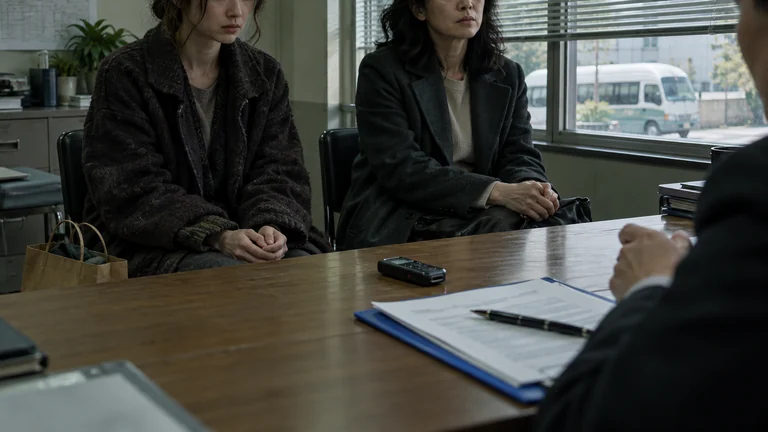
Across the interview table, the officer lifted his pen. He was a contractor, like Ruth, although his uniform had persuaded the woman otherwise. On the desk lay an agreement with a blue border. Ruth had been told this was a routine transfer interview.
"Finish the sentence," he said.
The woman watched Ruth's mouth. Her name was Salma. She'd arrived with a shopping bag of clothes and a small packet of photographs, which the officer had placed in a drawer before switching on the recorder.
Ruth repeated the woman's sentence correctly.
The officer turned the recorder off.
"We already have her history. You're here to establish consent."
Through the office window Ruth could see a minibus with its engine running. Two men stood beside it. One smoked without taking his eyes off the entrance.
Ruth had accepted the job because it paid in advance. Her landlord had already given her an extra week. When the agency said difficult material, she'd assumed grief, a familiar hazard. They hadn't mentioned a prepared translation.
It had been sitting beside the agreement when she arrived: a list of approved phrases in both languages. I wish to return. I have not been threatened. I am traveling voluntarily.
"Ask her to sign."
"She hasn't said any of this."
The officer glanced at the recorder.
"She said she wanted to be with her husband."
"Because he's dead."
Salma leaned forward. "What is he saying?"
Ruth told her.
The woman pulled her hands into her sleeves. She hadn't cried when she described the burial. Now her breathing changed.
"That man outside," she said. "The one with the scar by his ear. He was there."
Ruth looked at the smoking man. He rubbed his ear with his thumb.
"She recognizes your driver."
The officer stood and closed the blinds.
Their phones were in a tray outside. Security, he'd said. Ruth's coat hung on the back of her chair; her bag was underneath it. She'd started her dictation recorder inside the bag when he told her to use the approved phrases. If anyone disputed the transcript, she wanted his instruction on tape. It had been running ever since.
On the wall beside the closed blinds was an evacuation plan. Ruth followed the green line from this room to the fire door at the far end of the corridor.
"I need the bathroom," Ruth said.
"After the signature."
He placed a hand on the back of Salma's chair. Salma moved away from it.
Ruth had once translated witness testimony through a whole afternoon while a barrister called it unreliable. The witness had thanked her afterward. Accuracy was the part Ruth could promise. She'd built a modest life around that promise, and this morning she'd abandoned it before the first page was finished.
She picked up the agreement.
"If you want it accepted, I have to read the whole declaration in both languages. With the recorder on."
The officer considered this. Then he sat down and pressed the button.
Ruth began in English, reading the sentences he'd given her. In Salma's language, she said something else.
"When I push back my chair, take the bag and get out of the room. Go left. There is a fire exit at the end. Run toward the road."
Salma stared at her.
"Keep looking at the paper. I am sorry. I should have believed you sooner."
The officer tapped the agreement.
"That's taking a while."
"There isn't a direct equivalent for voluntary."
Ruth reached under her chair for a pen. Her fingers found the recorder. She slipped it into Salma's shopping bag and put the bag beside the woman's feet.
Then she pushed back her chair.
The officer stood as Salma moved. Ruth drove the chair between his knees. He caught her by the hair and struck her against the table.
She heard the fire alarm. Salma had reached the door.
The officer dragged Ruth toward the corridor. Blood ran into one eye. At the entrance, the smoking man was running across the parking lot, but a delivery truck had stopped on the road and Salma was climbing into its cab.
Ruth began shouting the building's address. She shouted until people appeared at the windows of the offices opposite.
The man released her hair.
By the time the police arrived, the minibus was gone. The officer had left through the same fire door Salma had used. Ruth sat on the curb trying to answer an investigator's questions through her swollen mouth.
At the hospital, a detective played the recording back to her. The agency's payment reference and the hired office gave them places to start. Salma was safe, he said. They would need Ruth's statement.
On the recording, her calm, professional voice said the husband had left the country.
"Who translated that part?" the detective asked.
Ruth could hear Salma on the recording, still trusting her, offering the details of a man's last minutes to the only person in the room who could understand them.
"I did," she said.
The detective moved his pen to a fresh line. This time Ruth waited until he had written down exactly what she'd said.