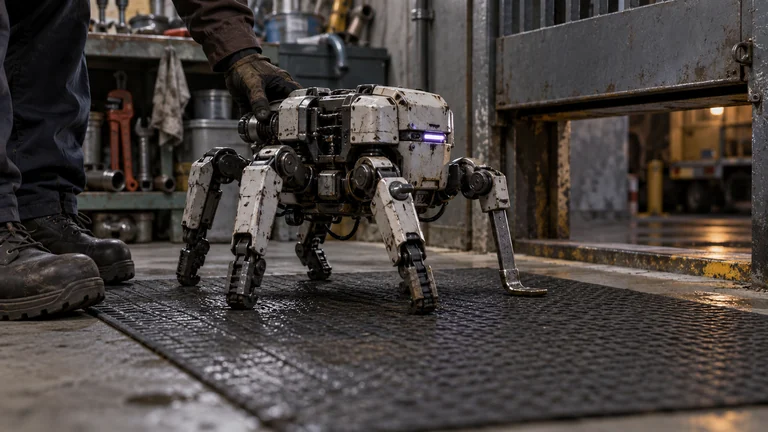
Unit 618 returned with five legs and a gutter bracket where its sixth leg had been. It crossed the inspection mat without limping, using the bracket whenever the floor was level and lifting it carefully over the raised edges.
Len marked the bracket as an unauthorized modification. She had three hundred more units to inspect before the renewal meeting, and the software would not let her close the record without identifying an error.
The little machine waited for her to open the return gate. It had no face. Its number was etched into an upper plate that had been polished bright by years of passing through narrow spaces.
"Where's the leg?" she asked it.
The maintenance display showed a location and a work order. Len opened the corresponding photograph. A steel foot had been fused into a split pipe coupling beneath the south school. The foot's curved housing fitted the fracture better than the standard repair strip would have done. It was keeping sewage inside the pipe.
She removed the error designation.
The software asked her to restore the missing component before returning the unit to service.
The municipal swarm had been sold as a closed system. Broken units donated parts to working ones. Working ones manufactured replacements from recovered metal. With careful accounting, the original material stock should last indefinitely. The council's maintenance reserve had been reduced each year as the fleet proved its efficiency.
Len had used that phrase herself: original material stock.
Unit 618 waited beside the gate while she searched the next record. Two legs had become reinforcement in a lift shaft. A casing held open a collapsed drainage channel. The machines had used their bodies where the shapes were useful, exchanging temporary mobility for durable repairs. Their service objective measured whether the work remained sound. It did not require the repair material to remain attached to a robot afterward.
Every donated part was still recorded as recoverable stock.
The annual figures were perfect because they counted the same metal as both an available machine and a permanent part of the city.
At the meeting, the procurement officer asked why nobody had noticed.
Len had brought Unit 618 in a tray. It climbed out, crossed the table and examined a loose fixture under the presentation screen. She caught it before it could begin work.
"Because we asked whether the repairs were holding. They are."
The officer proposed collecting the embedded parts during the fleet's scheduled refurbishment. They could use ordinary replacement fittings in the buildings and return the specialized material to the robots.
Len showed him the pipe under the school.
"We'll have to close that section to replace it."
"Then schedule it."
She showed him the lift shaft, a retaining wall, the expansion joint beneath the hospital loading bay. Each extraction would require a new repair, material, access and somebody to do it. The missing cost occupied the whole city.
The officer asked whether she was saying the system had failed.
She looked at the photographs. "The repairs worked."
They deferred the renewal until she supplied a complete material reconciliation. The procurement officer agreed that embedded parts could not be counted twice. He needed their locations and replacement costs before authorizing more material. He had no reserve fund to release while she did the counting.
At home, Len took the retired fabrication kit out of the cupboard. She had used it to make fittings for neighbors before the swarm made that sort of favor unnecessary. She printed a replacement leg from her remaining workshop alloy. Unit 618 checked its tolerances, marked itself available and waited for work.
The first call came from the west laundry. A valve inside the narrow return duct had split. Water was reaching the floor above the building's electrical intake. The main supply could be shut off, but it also served two blocks of apartments, and access to replace the valve required dismantling part of a load-bearing service wall.
Len took 618. Other mobile units were available in four hours. The laundry manager had closed the main supply and turned off the power. The apartments now had no water, and the laundry's first delivery of work clothes was due in an hour.
Inside the duct, 618 found a repair that needed no new material. Its central chassis could bridge the split housing and fuse to the sound metal on either side. The unit would have to remain there, without enough frame left to carry its tools back out.
The inspection display offered a second solution: a fabricated sleeve of the same alloy. Len had used the last of her stock to make the new leg. The nearest listed reserve was already reinforcing the school's sewage main. She crossed it off with a wet finger.
"Will it fix it?" the manager asked.
"Yes. But I lose the machine."
He looked at the power intake, then at her case of tools.
"And the water?"
"That comes back."
She authorized the chassis repair.
The camera shook as the unit set its body across the fracture. It braced, warmed the contact edges and joined them in short sections. Len reopened the supply for the load test. The returning water stopped finding the gap. The unit pushed its detachable power pack toward the entrance on the leg she had made that morning, then disconnected the trailing cable. Len drew the pack out by its service tether. Everything else stayed in the wall.
The manager asked whether she could look at a jammed lint shutter while she was there. It was overhead, beyond the narrow turn where a mobile unit could have carried the right cutter. Len looked at the empty transport tray.
"We need a ladder. And somebody to help me take the panel down."
He fetched the ladder. The laundry remained closed while they worked, and residents went away carrying wet clothes in bowls.
That evening Len entered 618 as consumed in repair. The application prompted her to specify whether the unit had been destroyed or lost. She attached the pressure-test record and the photograph of its frame holding the valve together. Then she wrote how many hours the second job had taken without it.