Moss knew the storm by its smell.
Before the first drops reached the glass, there was a trace of hot stone, then the dark green smell of crushed leaves. The museum called it a preserved climatic event. Moss called it the afternoon her brother taught her to swim.
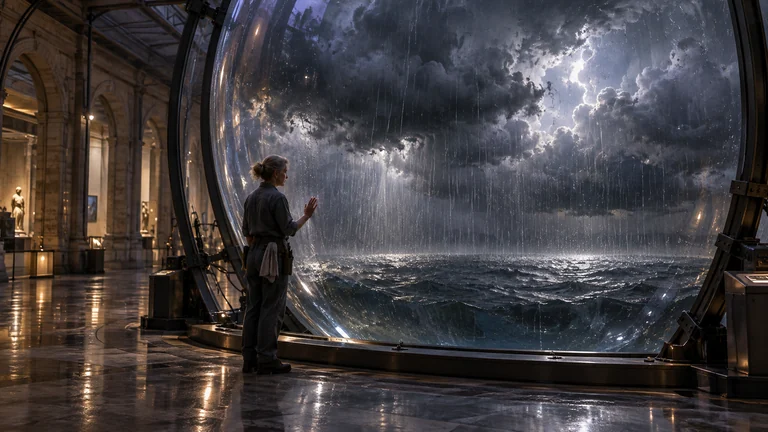
She'd been nine when the rain came down over the valley. She was fifty-three now, and it was still turning inside a pressure lens beneath the museum roof.
It was the same storm. The collection team had captured its moving air, its charge and water, keeping the system enclosed while the world outside was rearranged. The valley became a reservoir service zone. Her family moved to a city where rain fell only when the municipal schedule allowed it.
She took the museum job because it paid regularly and because, during maintenance, she could stand close enough to smell home.
Visitors viewed the storm from a dry gallery. Each afternoon, Moss adjusted the lens until rain struck the glass. Children pressed their hands against it. Their parents took photographs through the water.
Then Moss brought the storm back into its holding pattern. The water rose, condensed and waited. The museum had kept that one afternoon circling for forty-four years.
On a Tuesday morning, the director told her it had been sold.
"A private institution. Excellent conservation standards."
Moss read the transfer order. The buyer owned vineyards beyond the city. The storm would be dismantled, its water and stored electrical charge absorbed into a proprietary irrigation system. A recording would remain in the gallery.
"That's not conservation."
"It's an asset transfer."
The director offered her a severance package. The recording wouldn't require a weather keeper.
Moss went back to the gallery. A class from the school beside her apartment was watching the storm. Their teacher explained that people once experienced rain without protective barriers. A boy asked whether it had hurt.
"Sometimes," Moss said before the teacher could answer.
The boy looked at her hands.
"Did it hurt you?"
She remembered slipping on the bank, her brother laughing as he caught her. She remembered the rain hiding the far side of the river. She told the boy it was cold.
That evening she took the severance papers home. Her apartment stood above a repair shop in a district excluded from scheduled rainfall. The roofs had been maintained for dry weather for so long that most wouldn't keep out a shower.
If she released the storm, the prevailing wind would carry it over those roofs.
She laid the papers on the kitchen table and checked the forecast. She could free the weather. She couldn't choose who would be beneath it.
The following day she asked the municipal shelter office to open the covered market for a possible water-main emergency. She notified the repair shop and the school. She told the truth to the building caretakers: rain was coming, more than their roofs could hold. Several laughed. Others began moving mattresses and electrical equipment away from the windows.
By closing time, the storm was restless inside its lens. The transfer crew had begun reducing the holding field. Moss could see separate cloud structures losing their shape, their water drawn toward collection tanks.
She asked for one last maintenance pass.
The crew supervisor agreed. He'd watched her care for the exhibit for years.
Moss opened the release protocol used to protect the lens during a field failure. A warning appeared: uncontained weather could not be recovered as the same event. Beyond the field, it would exchange heat and water with the world and become something else.
She read the warning twice. Even if the museum caught every drop again, it wouldn't put that afternoon back.
The supervisor saw the protocol on her screen.
"Moss."
She looked at him. He put down his tools and went to open the roof vents. Neither of them called the director.
The lens dimmed. Wind crossed the gallery. For the first time since the museum opened, the glass was wet on both sides.
Moss stood beneath the rising cloud. The smell of the valley passed over her, and then it was gone, mixing with the city's dust and hot metal.
Rain began falling over the eastern district before she reached home.
It broke a gutter above the repair shop. The plastic she'd spread over her mattress collected water until one corner slipped off and emptied onto the bed. She spent the night carrying buckets with her neighbors while children shrieked in the courtyard, frightened and delighted.
The museum dismissed her. The director said the financial consequences were still being assessed. The transfer supervisor was dismissed too. Moss made sure everyone knew she'd initiated the release, though she couldn't make that protect him.
In the morning, the rain stopped. The city smelled of drains and wet brick. Her brother had been dead for twelve years, and the storm no longer existed in a form she could visit.
Moss went downstairs to help clear the repair shop. The schoolboy from the gallery was outside with his mother. He recognized her and held up his palms.
"It didn't hurt," he said.
Moss looked at the ruined stock behind the shop window, then at his open hands.
"I'm glad."
He had caught some rain in a cup. He offered it to her as if she'd lost something and he'd found a little of it. Moss took the cup, thanked him, and poured the water into the soil around the street's only tree.