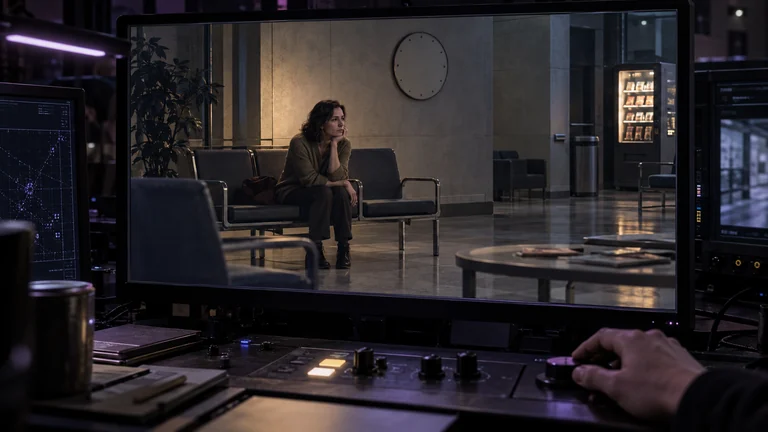
The passenger in holding had missed the same connection for eighteen years.
The public departure record showed a delay of less than a second. Kez found the retained packet during a routine overnight audit. It was cycling between two terminal addresses, asking each one for permission to arrive.
Neither terminal accepted it. Neither deleted it. The error report called this harmless retention.
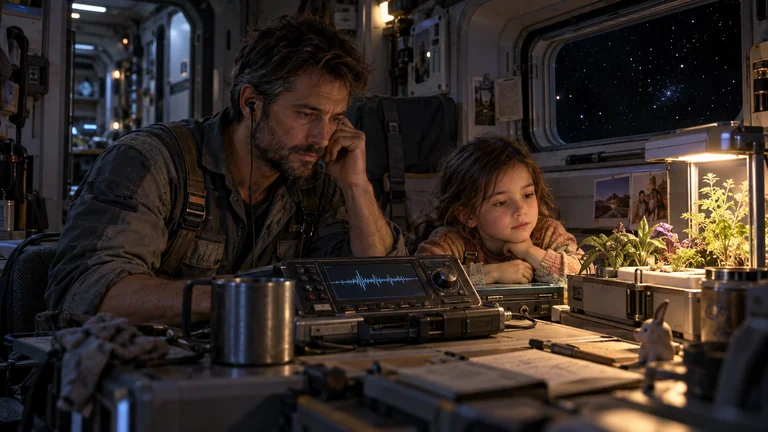
Kez opened a diagnostic channel, synchronizing the retained mind's processing rate with her own time.
"Please," a woman said immediately. "Don't close it again."
Kez took her hand off the control.
The woman gave her name as Amina Dorr. She was thirty-seven, traveling to a trade conference, carrying a small blue suitcase. Her recorded biological age matched. Inside the buffer she'd experienced eighteen years of a waiting room assembled from her own short-term memory.
The wall clock had no hands. The vending machine displayed photographs of food she couldn't need. There had been a blue suitcase at first, but she'd forgotten what it looked like, and the room had stopped including it.
Kez checked the departure log.
Amina Dorr had arrived at her destination on time.
"Your transfer completed," Kez said.
The woman closed her eyes. "That's what the others told me."
Not other technicians. Other automated diagnostic voices, years apart in her experience, each ending when its error scan was complete.
The transfer had produced a duplicate processing state. The main packet arrived. A redundant branch remained active, generating the internal simulation the system used to maintain a mind during routing. The fault had accelerated that simulation instead of holding it briefly between instants.
Kez looked up Amina's current address. Her conference hotel was forty minutes from the terminal. Her whole ordinary day had continued while another version of her spent eighteen years trying to remember the pattern on a suitcase.
Kez called the overnight manager.
"Follow the duplicate-state procedure," he said. Kez opened it. The last instruction was PURGE.
"She's talking."
"So would any complete passenger file."
"She has memories the passenger doesn't have."
He asked her to read the error code back. She did. He gave her the same page number.
He told Kez he'd come down in twenty minutes. She was to leave the channel closed until he arrived. Keeping it open increased the liability exposure.
Kez left it open.
"Do you still have a body?" Amina asked.
Kez looked at her own hands. "Yes."
"Could I see you?"
She switched on the desk camera. Amina moved close to the diagnostic window. Kez could see where the simulation had simplified her hands, leaving the nails almost featureless. The woman's attention kept restoring them, then drifting elsewhere.
"You look tired," Amina said.
Kez called the address on the completed passenger record. A sleepy woman answered. The same voice, without the careful pauses.
"There was a transfer fault," Kez told her. "I need you to come to the terminal."
"Am I all right?"
Kez looked at the waiting room.
"I don't know how to answer that."
Reconstruction wasn't the obstacle. The terminal had matter reserves and an available arrival chamber. It could give the retained mind the same body plan that had left the departure station. The obstacle was the identity register. One active person per transfer. A second arrival would be classified as unauthorized replication.
The manager's access badge appeared on the building map. He was walking from the parking area.
Kez told the woman in holding what arrival would mean: no valid identity record, no automatic claim to the first Amina's property, a legal dispute the terminal had never allowed to occur.
"You could also be destroyed," she said. "That's what he's coming to do."
Amina looked at the vending machine. "I know."
Kez could route the packet into an unassigned reconstruction chamber under the emergency recovery protocol. Her own authorization would be recorded. She would have no way to call it a mistake afterward.
She entered it.
The waiting room vanished from the diagnostic display. For several seconds there was no voice. Then the arrival chamber announced a completed reconstruction.
Amina stepped out wearing a terminal robe, physically thirty-seven. She crouched and touched the floor. Kez waited while she pressed her cheek against the cool tile.
The manager arrived, saw the robe and stopped.
"What have you done?"
Kez gave him the audit log. The reconstruction had created a living person in front of two security cameras. He could report her. He couldn't quietly purge the body standing beside her.
The first Amina reached the terminal shortly afterward. She wore a coat over her pajamas. When she saw the woman in the robe, she put a hand against her own mouth.
The other woman did not mirror the gesture. She was watching the automatic doors, fascinated by people entering and leaving whenever they chose.
"That's my face," the first Amina said.
The woman in the robe touched her cheek. "Did you ever get rid of the suitcase?"
"It's in my room."
"I used to open it and put everything back. I wanted to make sure there was still a reason to leave."
They sat together while the terminal called its lawyers. One remembered that morning's breakfast. The other remembered inventing breakfasts to mark the passage of years.
The first Amina took off her coat and offered it. The woman from holding hesitated, then wrapped it around her shoulders.
"Do you want me to call our husband?" Amina asked.
The woman looked down at the borrowed sleeves.
"I'd like to go outside first," she said. "By myself."