The peace had been twenty-two years old when Ilan fired the first pulse. He learned this eighteen years afterward, on the morning they brought him back to fire the second.
The arithmetic was simple. The other world lay forty light-years away. Its announcement had spent forty years reaching them, and the weapon he had helped launch still had twenty-two years to travel. Nobody had held the news back. Nobody had forged the date. Light had carried the greeting as quickly as it carried everything else.
The driver waited while Ilan finished reading it.
"They have the packet at the installation," she said.
He left his breakfast on the table.
The old beam hall had acquired a visitor entrance and a permanent exhibition. His photograph stood beside a scale model of the first launch array. In it he was forty-seven, leaning over a calibration display with his sleeves rolled up. He remembered being told to stay there while the photographer moved the light.
Director Saye met him beyond the exhibition. She had been a junior operator at the first launch. Now she had the careful, economical movements of somebody whose schedule belonged to other people.
"You've seen it."
"All of it?" he asked.
"We've been receiving the archive in sections for six months. The certification came overnight."
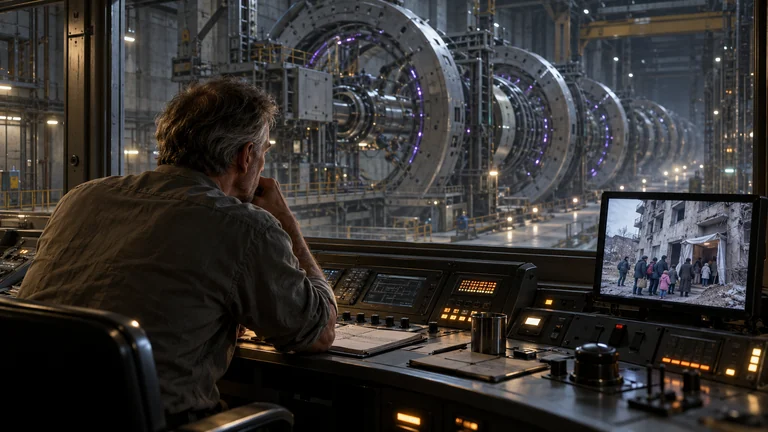
The archive described the collapse of the old regime, trials, food distribution, disputed elections. The new government's greeting was cautious. Its speaker asked whether the former enemies could begin exchanging scientific visitors. Behind her stood a damaged public building with people going in and out through a temporary door.
Ilan recognized the building from the targeting model.
In the launch room, the first pulse appeared as a point advancing along a forty-year line. Its energy was traveling through empty space in the engineered beam geometry they had spent half their lives developing. It could not receive new instructions. Another signal would follow behind it forever. Whatever lay in its path on arrival would meet the decision he had made at forty-seven.
The second array was ready. Building and charging it had taken eighteen years. The paired campaign was designed to strike infrastructure first, then prevent recovery. The target models had treated the enemy government as something as permanent as the planet's orbit.
"We can cancel this one," Ilan said.
"Yes," Saye answered.
He was grateful that she did not begin with a technical obstacle. There were none. The stored energy could be discharged safely. The second targeting solution could remain an unused calculation. They would lose money, careers and an argument the administration had been making for eighteen years.
They would not have to fire.
Saye brought up the revised strategic assessment. By the time the first pulse arrived, the peaceful government described in the packet might have changed again. It might have become hostile. If it remained peaceful, the attack could make it hostile. Survivors would eventually identify the origin of the beam.
The assessment used this uncertainty to recommend completion.
Ilan read it twice. The first reading was for the reasoning; the second was to see where his name appeared. His original assurance about the need for paired launches occupied most of a page.
"That was a different government," he said.
"It was also your assessment of their recovery capacity."
"Recovery from what we do to them."
Saye nodded. She had not missed the implication. Nobody in the room had missed it. That left him without the relief of correcting them.
An operator asked whether they should pause the final sequence. Saye looked at Ilan. The old authorization required his technical certification because the surviving knowledge of the first array was partly in him. They could replace him through a longer review, but they had chosen to bring him here and make refusal personal.
He thought of the exhibition outside. It had seemed faintly embarrassing when he passed it, a younger man's importance preserved too brightly. Now he pictured workers taking his photograph down while visitors asked why.
He asked for the greeting to be played again.
The speaker at the damaged building introduced herself as an interim representative. She made no promises on behalf of her descendants. There were arguments behind her; someone passed carrying a folded table. She turned briefly to help another person catch the door before it closed.
Then she faced the camera and asked for a reply.
Ilan calculated when a reply sent today would reach her world. Eighteen years after the first attack. At the same time as the second, if he authorized it. No message he wrote could arrive in time to explain the light already on its way.
He let that fact occupy all the space in his mind where the other fact belonged.
The second pulse had not yet left.
He certified the solution.
Saye put her palm on the release control. The operators completed their separate checks. There was no visible flash in the room, only a change in the cooling load and a second point appearing at the beginning of the plotted line.
The greeting continued on a side display. Its speaker had reached the part about visitors. Ilan watched her hold the temporary door open for the person with the table, then turn back toward a camera forty years away.