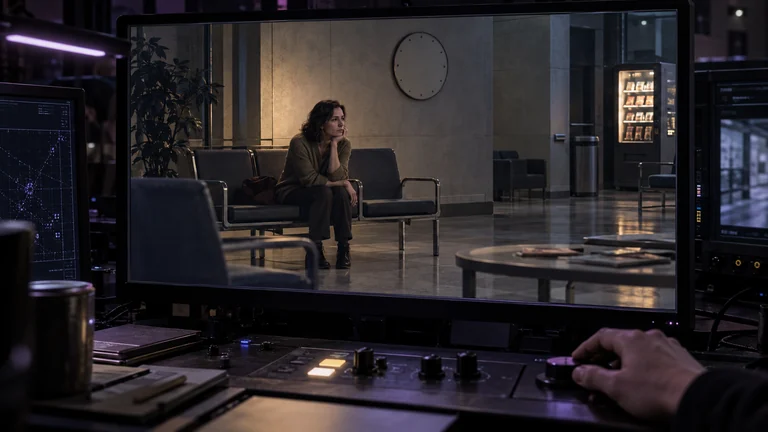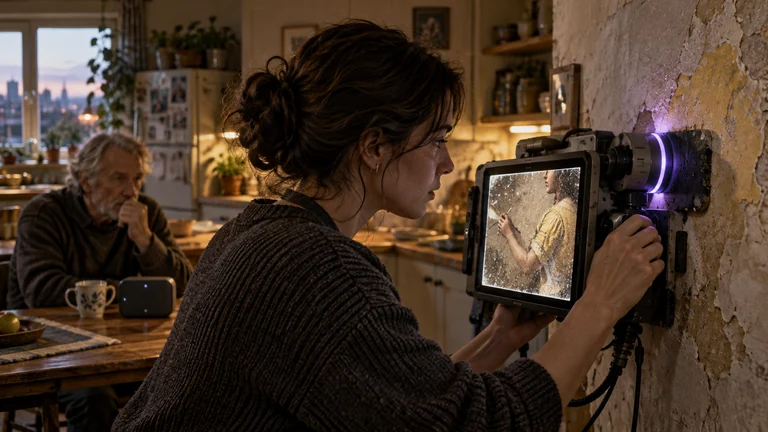
The first thing they recovered from the wall was Imani's mother singing badly.
She'd been painting the kitchen. The reconstruction showed a yellow sleeve moving past the wall, a brush entering the frame, then her face as she leaned close to inspect a drip. The image had the narrow perspective of the mineral grains that had stored it. It could remember only what light and vibration had brought to that patch of plaster.
Her mother had been dead for seventeen years.
Imani's father asked the technician to play it again.
The demonstration was meant to reassure them. Retrospective recovery helped solve crimes, preserve family history and establish the truth of disputed events. Their landlord had agreed to let the company sample every apartment in exchange for a maintenance grant.
The technician smiled while Imani's father listened.
"We can make a personal copy for a small fee."
The mineral memory had existed long before anyone could read it. Ordinary walls retained faint structural traces of sound and light. Only surfaces exposed to the room held enough information for a usable reconstruction. The new instruments assembled those traces into partial scenes. They couldn't see around corners or read minds. They could recover a conversation that nobody had agreed to record.
Wealthier buildings were already being renovated with material that retained no readable trace. The advertisements called it architectural privacy.
Imani repaired furnaces. She knew what it cost to destroy a mineral lattice and make it again. She also knew why the maintenance grant didn't include new plaster for their building.
Three days after the demonstration, an officer came with an order to sample the kitchen.
Her daughter, Lale, had met two workplace organizers there the previous month. They'd discussed refusing a compulsory contract extension at the water plant. The plant called it a coordinated threat to essential supply.
Lale had already lost her job. The officer said the recovered conversation could clear things up.
"For whom?" Imani asked.
He handed her a notice and said the sampling team would arrive at eight the following morning.
After he left, her father sat at the table with the little speaker playing his wife's song. He'd paid for the copy. It ended each time her face moved beyond the sampled wall's field of view.
"They'll hear what she said," he told Imani. "Then they'll know she didn't threaten anyone."
"They can choose which part to play."
He turned the speaker off.
The conversation had taken place at the table, against two walls and a tiled floor. Destroying one sample would achieve nothing. The company could take another. The landlord owned the walls, and the notice forbade alterations before the investigation.
Imani could let them listen. There was nothing in the conversation she considered wrong. She kept returning to that fact, and to the way the officer had said clear things up while looking at the photographs of her daughter.
She called a friend who operated the building-materials furnace where she worked. Then she told Lale and her father they would need somewhere else to stay.
Her father looked around the kitchen.
"All of it?"
"Enough that they can't listen from another angle."
They sorted the loose objects first. Anything with a readable mineral surface went into the furnace crates, including the tabletop and the cups they'd used at the meeting. Imani's workmates came after their shifts. They stripped the walls, ceiling and floor until the kitchen was a hollow room of exposed supports. Every exposed layer went with the crates.
The heat that remade the material would leave no old arrangement to read. Imani had spent years doing that to make clean building panels for wealthy clients. Tonight she used the same process for people who couldn't buy the finished product.
Her father stayed until the final section of plaster came down.
"Your mother is in there too," he said.
"I know."
He lifted one fragment. A little yellow paint remained beneath several newer coats. He asked whether they could keep it.
Imani looked at him, then at Lale standing beside the doorway.
He put it in the crate himself.
At eight, the sampling team found an empty kitchen and Imani waiting with the alteration notice in her hand. She was arrested for destroying material subject to an order. The landlord began eviction proceedings before she was released that evening.
The recovered fragments from elsewhere in the apartment contained ordinary life and no usable account of the meeting. The organizers' case continued on other evidence. Imani couldn't know whether she'd changed its outcome. She knew she hadn't given them the kitchen.
They moved into two rooms behind her friend's workshop. Her father brought the little speaker. Lale brought the table, which they had remade from blank material before using it again.
Imani used what remained of her savings to line one room with the same unreadable panels she'd installed in executives' houses. It was small, badly ventilated and entirely theirs to speak in.
The speaker stood on a shelf. Her father played the fragment often, but he never tried to supply the rest of the song. When it stopped, he let it stop.
One evening, in the little room, he told Lale he'd nearly kept the piece of yellow plaster.
"I know," she said. "I saw you put it back."
"I mean after you went downstairs. I went to the crate."
Lale looked at Imani, who shook her head.
"Did you take it?"
"No."
"I stood beside the crate until I heard you coming back upstairs," he told Imani.
Lale pulled out a chair and sat facing him. He hadn't looked at her since she asked whether he'd taken it.
"I had a place for it," he said. "Behind your photograph."