They wanted me out of the photograph because I was holding the mother.
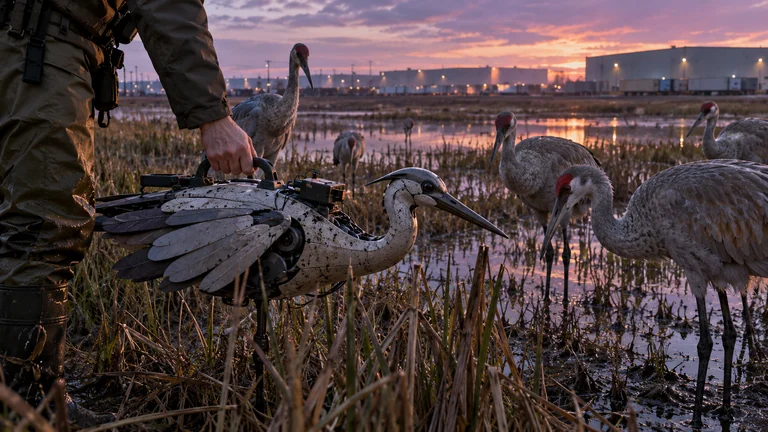
The mother was a drone with a folding wingspan and six batteries in its belly. I had one arm through its maintenance handle and the other under the damaged left wing. In photographs it looked like a bird if the photographer stayed far enough away. Up close it looked like something I was carrying to a repair shop, which was where it usually needed to go.
The living birds gathered around my boots, making the drone's startup noise.
Nobody had expected that part.
The marsh crowns had been extinct for ninety-three years. The reconstruction team recovered enough material from preserved specimens to rebuild a viable genome, and a related species carried the first eggs. The birds emerged with the right feathers, the right long toes and no adult marsh crowns to show them what to do next.
Migration, it turned out, had not been inside the eggs.
That was why they hired me. I flew survey drones. I also knew the coast because I had spent several years being paid to document its deterioration, a qualification the restoration director described as local enthusiasm.
We hatched twelve birds. They followed the drone, slept beneath its parked wings and screamed when its battery alarm sounded. I changed the alarm to a soft click. Within a week they clicked at me when they wanted food.
The official migration route came from a naturalist's notebooks. It ran through reed beds now buried beneath a distribution center, crossed a drained estuary and ended at a freshwater marsh connected to the sea by a storm breach. The maps looked convincing because they had old water on them.
I submitted a current route assessment. The director thanked me and said the ceremonial release was already announced. We could make adjustments after the first historic flight.
"The birds will follow me there."
"That's the point."
I had taught them that my direction meant food and a place to sleep. They were very good pupils. When I flew over a bare concrete apron, they circled until I landed. When I took the drone too high, they climbed beyond the easy part of their breathing rather than leave it.
I found another route used by the gray stilt-crowns, their living relatives. The two species could forage in the same water, and the gray birds stopped at a chain of working reed beds the historical map had never considered. None of this guaranteed the marsh crowns would follow them. At least there was something to eat if they did.
The director asked whether the gray birds would change the behavior we were trying to restore.
"I hope so."
She told me to keep that answer away from the visiting donors.
On release day, they fitted a new shell to the drone so the repairs would not show. A donor's name went beneath one wing. The photographer asked me to lower it, then to stand outside the frame. The birds followed me out of the frame too.
We eventually photographed them with a tray of food.
I flew the approved first leg. The twelve rose through the morning haze in a loose uneven line, and for a while I understood why people wanted the old route so badly. There was enormous pleasure in seeing something that had only existed in photographs decide how far apart to hold its wings.
At the estuary junction, I turned inland.
The director called immediately. The tracking display showed the deviation. I told her where I was going and how much flight time remained. She told me the donor feed was live.
I had enough battery to reach the active reed beds, land and wait. I had checked the gray flock that morning. They were feeding in the shallows, preparing for the next stage of their route.
The marsh crowns landed around the drone. One pecked its cooling grille. Another put its head beneath the new wing shell. The gray birds withdrew a little, then returned to the richer water beyond them.
I opened the drone's food compartment. It was empty. For the first time, staying beside it did not produce what I had taught them to expect.
They waited.
I watched through the belly camera until I wanted to start the motor just to give them something familiar. The youngest kept clicking. Its long toes sank slowly into the mud.
A gray bird caught something in the shallows. One of mine went to look. It found food of its own. Then another followed.
When the gray flock rose, nine marsh crowns went with them. Three remained beside the drone. I waited another hour and brought those three back for further work.
The director suspended my flight clearance. The donors received an explanation about unforeseen behavioral variability. I gave the tracking team the current route and stayed available to help if the nine got into trouble.
Their tags showed a stop at the next reed bed. Two days later, a field worker sent me a recording from the flock. Among the calls and wind was the drone's old startup noise, passed from a living throat to another.
I played it once. Then I went to feed the three still waiting for me.