Luda asked him to release the lower branch while there was still blue between the clouds.
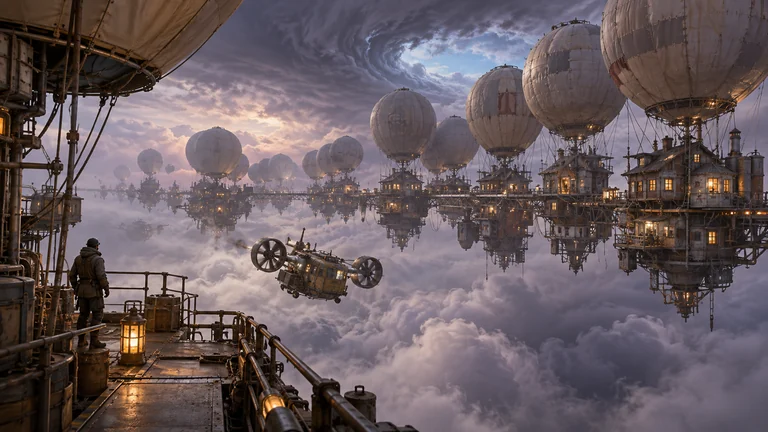
Osric could see her tug from the navigation platform. Its little fans kept changing angle as it worked beside the town's tow spine. Below it hung sixteen households, their heated lift sacs dimmed by the mist rising from the cold layer. There was nobody underneath those houses. Beneath the mist lay thousands of kilometers of atmosphere, growing denser and hotter until the idea of a surface ceased to be useful.
"We can climb separately," she said. "Now."
"And drift east for a year."
"Then we drift east."
He checked the upper route. The commercial platforms had enough reserve lift to clear the storm, but towing the lower homes required a slower ascent. The forecast still gave that ascent a workable corridor. It was narrowing; it had not yet closed.
Osric had navigated the town for nineteen years. People told stories about the season he brought them through a field of falling ice without losing a window. Nobody remembered the routes that had worked ordinarily. He had begun to think of those ordinary routes as proof that keeping everyone together was itself a kind of safety.
Luda had once shared his cabin. She had moved to the tug after their separation because it required her to ask nobody which way to point its fans. He disliked remembering that now, when her calculation deserved to be considered on its own.
"Give me twelve minutes," he said.
She was quiet long enough for him to hear the fan motors through her microphone.
"You're spending their lift."
The lower houses were lighter than the upper platforms but had less insulation. In warm air, free of the tow, their sacs could expand and carry them into a different current. If the cold layer reached them first, they would have to burn reserve gas to recover the lost volume. After that they would depend on the town to pull them up.
He knew the rule. He had taught it to Luda.
Osric sent the order for a common ascent. Along the tow spine, winches shortened the gaps between branches. Kitchens and workshops rose past his window, their occupants already securing cupboards. The public channel filled with the small indignities of preparing for rough air: a broken latch, somebody unable to find a cat, a man who insisted the forecast looked worse from his bathroom.
Then the lower camera went white.
Luda's voice remained clear. "We're in it."
He raised the upper fan setting. The spine tightened. On the load diagram, the bottom branch changed color.
"Release us," Luda said.
Osric authorized the branch release. The main coupling opened, but the safety line took the load before the houses could drift clear. Without enough lift, their weight had pulled its lock shut. The line existed to save a branch after a coupling failure. Now it kept the sinking homes attached to the whole town.
Luda reached it with the tug.
The next image showed her working through a service opening, one gloved hand inside the coupling. Ice formed on the rim. Behind her, a house window lit and went dark as somebody moved a lamp.
"I can free the lock," she said. "Keep it slack."
Osric could give her slack only by descending. He lowered the fan setting. The entire town dropped toward the mist. On the upper platforms, reserve alarms began to sound.
The trade hall master called on the private channel.
"How many below?"
"Sixteen households. Tug crew."
"How many above?"
Osric did not answer. The numbers were available to both of them.
Two of the lowest houses had gone out of the image. Their branch lines angled downward beyond the camera's range. Someone on the public channel asked why the floor was sloping. Another voice kept calling a house number, as though the occupants might simply have missed the instruction to answer.
Luda's hand came out of the service opening.
"The pin's bent."
He could see how she would have held it before she showed him: turned between finger and thumb, presenting the fact without decoration.
"Get clear," he said.
"There are people at the crossing."
The emergency cutter was on the upper end of the safety line. Osric uncovered its control. Once severed, the line could not be recovered before the lower branch passed beyond their lift range. The tug might carry a few people. Its fans could not support houses.
He called a warning on every channel, counted ten seconds and cut.
The navigation platform lurched upward. Osric's knees buckled under the sudden acceleration. In the lower image, the loose line whipped past Luda's tug and the camera spun. The signal vanished before he could see which way the tug fell.
The town emerged into clear air thirty minutes later. Eleven people came back aboard an auxiliary skiff launched from the lowest surviving platform before the cut. Two carried a third person between them. None had seen the tug after the line broke.
Osric searched until the storm swallowed the remaining signals. Some could have drifted out alive beyond reception. He entered them as missing.
That evening the remaining households asked for a common course. Their individual reserves were depleted. The storm had left them unable to separate safely.
Osric calculated the route and sent it. Outside his window the town turned together, responding to the same order with less resistance than it had that morning.