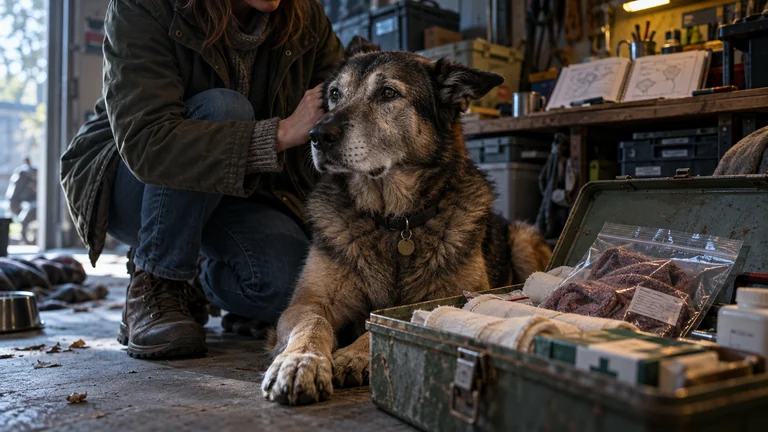
Bracken found the missing woman in an old first-aid box.
He sat beside it and waited for Maren to notice, his old tail making a narrow sweep across the concrete. He'd been retired for four years. Maren had brought him along because Martin's widow said she was frightened to be alone in the house.
Martin had been Maren's search coordinator. Now he was six days dead, and his garage contained equipment the department said it had no record of owning.
"Good boy," Maren said automatically.
Under a bundle of expired dressings lay a folded scarf in a plastic evidence bag. The label bore a woman's name, a date and the case number Maren had quoted in court fourteen years earlier.
The woman's husband was still in prison.
Bracken pressed his head against Maren's knee. She hadn't given him his reward.
Behind the first-aid box stood a row of storage boxes. Maren opened the nearest. Gloves, a child's sock, two handkerchiefs. Each had a case label. Underneath lay a notebook recording dates and search locations.
In the margins, Martin had drawn little diagrams of where Maren should stand. The scarf's case number appeared beside an entry dated the morning of the search: Placed at third fence post before handler arrival. Media attending nine o'clock.
She knew those positions. He used to guide her into place before releasing the dog. Better wind, he'd say. Better ground.
One page contained a sentence underlined twice: Handler follows the indication. Handler must not see the placement.
Maren sat on an upturned bucket.
The garage door moved behind her. Martin's widow brought two mugs of tea.
"Is it valuable?"
"Did anyone ask you about these boxes?"
"Superintendent Bell. He's collecting them at eleven."
It was ten forty-two.
Maren had searched for the missing woman along a railway embankment. Bracken had indicated a patch of earth. The body was never found there, but the prosecution had presented his response as support for other evidence. Maren had testified to what she saw.
She could remember the husband's expression when she said reliable.
"Call your daughter," she told the widow. "Ask her to come get you."
"Why?"
"Please."
Maren photographed the notebook. She sent the pictures to the lawyer whose number she still had from an inquiry into an unrelated case. She wrote that the originals were in Martin's garage and asked him to call her immediately.
Bracken moved to the next box and sat.
"Enough," she told him.
Her sharp voice made him lower his head. She touched his ear, but he wouldn't look up.
Bell arrived before eleven. His car stopped across the driveway, blocking hers. He wore a sweater instead of a uniform.
"Maren. Didn't know you were helping."
He looked at the open boxes. Then at the dog.
"We should talk inside."
"These came from cases."
"Training materials."
She held up the notebook.
"Training me?"
Bell stood very still.
Beyond the garage, the widow's daughter was helping her mother into a small blue car. Maren was glad she'd arrived. Then she saw Bell watching them leave, and wished she had asked them to stay.
"Martin was careless with his notes," he said.
"The scarf was planted."
"You don't know that."
"He wrote it down."
Bell stepped forward and held out his hand for the notebook.
Maren put it inside her coat.
"I sent photographs."
"To whom?"
Her phone rang. She answered and put it on speaker. Bell reached for it before she could speak. It fell between them. He put his shoe on it.
Bracken growled.
Bell picked up a length of wood from the workbench. Maren caught the middle of it before he could bring it down. They struggled across the garage, knocking over a box. Evidence bags slid through the dust.
She shouted for help.
Bell shoved her against the shelving. Pain went through her shoulder. Bracken barked, a deep sound he hadn't made in years. Across the fence, a neighbor called out.
"Call the police," Maren shouted.
"I am the police," Bell said.
The neighbor hesitated. Maren heard that hesitation more clearly than anything else.
Then the lawyer's voice came from her cracked phone, asking whether she could hear him.
Bell looked down at the phone. The call was still connected.
The police arrived while the neighbor stood filming over the fence. Bell told them there'd been a misunderstanding. Maren gave an officer the notebook before allowing anyone to help her sit down.
The cases took months to reopen. Some convictions had other evidence behind them. Some didn't. The investigation couldn't turn every indication into a lie, or make every prisoner innocent. It could show what Martin had planted and what Maren had unknowingly helped present as discovery.
The missing woman's husband was released the following spring. The appeal had exposed problems beyond the dog search, including a witness statement Bell had altered.
Maren waited outside the courthouse with Bracken. She'd written asking whether the man would meet her. He hadn't replied.
He stopped when he saw them.
Bracken's tail moved. The man knelt with difficulty and put both hands around the dog's gray face.
"They sent you there, didn't they?"
"He didn't know," Maren said.
The man looked up at her.
"I was talking to him."
Maren stepped back. She held the leash loosely while the man rested his forehead against Bracken's, and waited for him to finish.