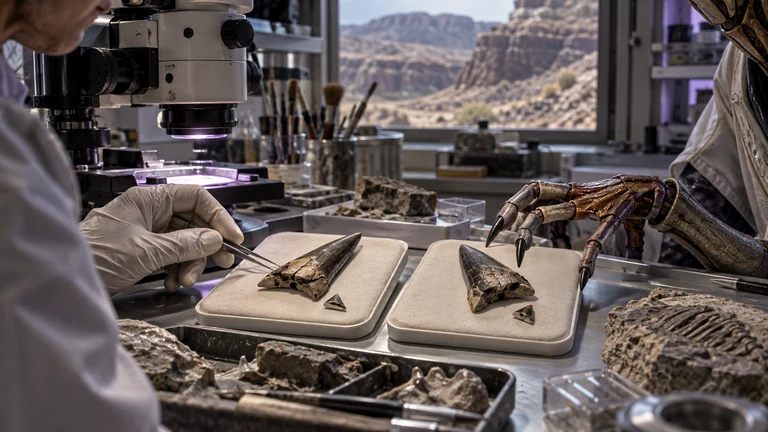
Bryn found the same broken tooth on two continents.
The specimens were seven hundred kilometers apart, in strata that should have differed in age by forty million years. Each tooth had a triangular chip near its root. Under the microscope, the fracture lines matched down to the smallest branch her instrument could resolve.
She asked Dov to check the accession records. He returned with the original field images, including one of himself holding the second specimen against a ruler. There had been no exchanged labels. The error was larger and more interesting than that.
For three days they worked without informing the settlement council. Dov slept across two chairs in the laboratory, his jointed legs folded beneath him. Bryn had never seen one of his people sleeping before. Awake, they arranged themselves so considerately around human furniture that she had mistaken the arrangement for their natural shape.
The isotope measurements were sound. The teeth were old, or had been manufactured with the ratios age would have left in them. More matching defects emerged in their collection. A fern had the same missing leaflet in four supposedly unrelated beds. A shell carried a dent through different stages of its alleged evolution.
The deep world had been furnished from a catalogue.
"How much of it?" Bryn asked.
Dov spread the survey map across the table. "We know where we've looked."
She disliked the answer because it was exactly what she would have said to somebody less careful.
The settlers had come from six systems. Humans were the largest group, but they had arrived last at the valley they now called First Home. When a reservoir dispute reached the common council, the human delegate argued that evidence of prior occupation should outweigh present population. She had expected old human probes to settle the matter. Bryn's survey was supposed to find them.
Instead it found a world whose past might be an industrial product.
At the lowest exposed bed, Dov located a conduit that had been disguised as a mineral vein. They followed it beneath a ledge. Inside was a chamber full of dust and a machine that recognized neither of their voices but accepted shapes drawn on its input plate.
Dov drew a spiral.
The machine made a shell inside a block of sediment. Its controls allowed variations in wear, burial pressure and isotope ratios. They tested the output at the field bench. It had taken eight minutes to make something their instruments described as seventy million years old.
"Don't touch anything else," Dov said.
He photographed the chamber from the entrance, including their footprints. He was already making an accurate record of the discovery. Bryn watched him attach measurement markers to the machine and thought of the reservoir hearings resuming in four days.
The human council had promised her a permanent laboratory if she established their claim. Her current appointment ended with the survey. The proposed laboratory had windows; she had spent fifteen years identifying other people's finds in converted storage compartments.
She asked Dov to take the printed shell to the laboratory for an independent assay. He wanted her to come too. She said she needed to map the chamber before someone disturbed it.
After his vehicle disappeared, Bryn opened her medical file. It contained a scan of her jaw from a dental reconstruction. She removed the implant from the model, changed the proportions and sent the shape to the plate.
The machine asked, in diagrams, how much surrounding material she wanted.
She selected more than she could lift.
By evening, a humanoid jaw occupied the middle of a newly grown bed at the chamber's far end. The sediment had fused to the old wall. Bryn chipped it out unevenly, preserving a section she would call undisturbed matrix. She photographed it from angles that excluded the equipment.
Dov returned before she finished packing.
He looked at the empty section in the wall, then at the case.
"Whose mouth?"
She did not answer.
He could have seized the case. He was stronger than she was. Instead he sat on the chamber threshold and waited while she fastened its straps.
"You can say I made it," she told him.
"Yes."
She had expected an argument. His agreement left her carrying the whole proposition by herself.
The council's human majority accepted the preliminary finding before the disputed-age review could convene. The new designation was protective: no further disturbance of ancestral sites pending investigation. Survey credentials held by other species were suspended within the reserve, which included the reservoir.
Dov filed his photographs and a dissenting account. They were entered as competing evidence. Nothing he knew vanished. Nothing he submitted required the majority to wait.
On his last afternoon in the laboratory, he asked Bryn to sign for the field equipment. She checked the cases against his list. One contained the shell he had watched the machine produce. He had marked it MANUFACTURED IN OUR PRESENCE, with both their names beneath.
"That should stay," she said.
"It is staying."
He left her the whole case. Through the laboratory window she watched him fold his legs into a passenger seat built for humans. The driver waited impatiently while he found a position that would hold for the journey beyond the new boundary.
On her desk, the two chipped teeth still matched. She turned off the microscope without moving them.