I gave them two more hours of shade. That was the improvement they put in the annual report.
The orbital sheets crossed the city on a daily schedule, changing their angle and separation to put a broad shadow over selected districts. Their paths had to be planned ahead. People imagined a hand moving a parasol across a table; I spent much of my working life explaining why the hand needed several days' notice and obeyed an orbit.
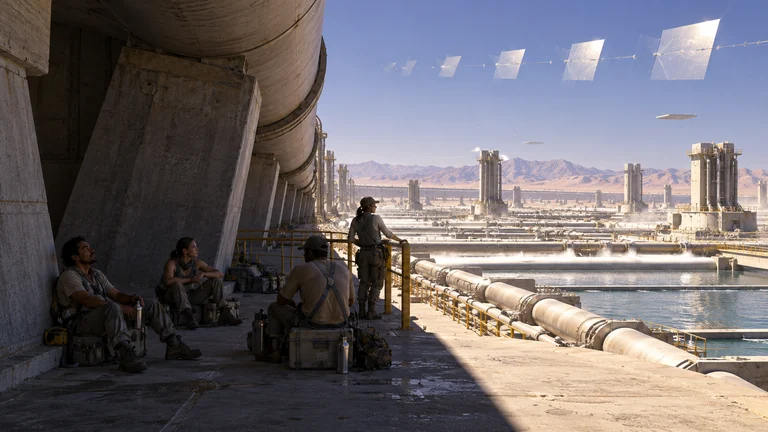
The western cooling works had always lost cover at noon. After that the pipes and concrete absorbed direct sunlight, and the crews stopped outdoor work under the exposure rule. Essential checks continued in short rotations. Repairs waited until evening.
I changed the sheet formation so its shadow stayed over the works until two. It took weeks of calculations and displaced a little agricultural coverage, which we recovered elsewhere in the schedule. The air did not suddenly become cold. What vanished was the direct radiant load, enough to bring the work zone below the threshold.
The crews thanked me. I went down there and saw people eating lunch without squeezing beneath the narrow shade of a parked vehicle. I remember that visit clearly because it was the last time I understood my work without qualification.
The heat break disappeared from the next roster.
Management had reclassified the two newly shaded hours as safe ordinary work. The repair backlog began to fall. The same report that praised my intervention praised improved labor utilization in the following paragraph.
A crew leader named Renn called me after three weeks. She asked whether I could return the shadow to its old schedule.
I explained how much safer the extended cover was.
"We're doing longer shifts."
"Without the heat."
"Still shifts."
She sent me the new roster. Overtime had been attached at both ends of the newly continuous day. A man had fallen asleep during an evening valve check. Renn had caught herself entering the same pressure reading twice because she could no longer remember which pipe she was touching.
She had asked for the rest period back. The response cited the improved exposure measurements.
I asked whether I should attend a meeting and explain the limits of those measurements. She said I was welcome to try, but the repair deadline was Friday.
At the meeting I explained that a lower radiant load did not remove the need for rest. Nobody disputed this. The contractor said fatigue was managed through existing supervision and that my figures established compliance with the specific heat rule. They thanked me for the clarification and retained the roster.
Afterward Renn asked again for the old shadow.
"They'll have to stop us at noon. It's automatic."
The monitoring system issued the stop when the threshold was crossed. Before my improvement it had done so every clear day. She was asking me to restore a hazard because the protection attached to that hazard was the only one the contract reliably honored.
I said I would not deliberately make her workplace dangerous.
"You already changed it deliberately."
I went home and opened the old formation file.
The following morning I submitted the rollback for the next available orbit cycle. I recorded it as a calibration trial. Renn told the crew. They planned to leave the exposed section as soon as the stop appeared, with the open work made safe before noon.
The contractor received the same notice. By the time the trial day arrived, the repair had been classified as uninterrupted essential maintenance. The automatic stop would become a warning requiring supervisory review.
I learned about the change at eleven forty.
There was no safe way to move the sheets back into the discarded formation on twenty minutes' notice. I called the works, the district supervisor and the contractor. Renn told me she was already trying to get her crew off the pipe bridge. Their supervisor required the valve housing to be closed first.
At noon the shadow left them exactly as I had calculated.
I watched the exposure figure rise. It was an accurate figure. Nothing in the instruments was broken.
At twelve thirty-seven Renn called for medical transport. One of the fitters had collapsed between the open housing and the rail. She stayed on the line while the others moved him under a temporary canopy. I could hear her counting people, checking who had gone with him and who was still on the bridge.
I scheduled the original extended cover for the next cycle. Emergency services used ground shelters that afternoon. My equipment, so large it could shade a district, could do nothing for a single man at the hour he needed it.
He survived. Renn took me to see him after he left the clinic. He asked whether the shade was working again, and I said yes. I could not tell whether the question contained an accusation. It did not need to.
The incident report identified an unauthorized reduction in environmental protection. I signed that part because it was true. My supervisor struck out the paragraph in which I explained the roster, calling it outside the technical scope.
The two extra hours remained. So did the new shifts. At the next annual review, the system's safety improvement was still measured from the period before I had provided them.