Senn learned the first turn in an engine shaft, carrying a lamp that had failed. The field ran through the wall on her left. Her implant translated its direction into a pressure she could feel behind the bridge of her nose, and she followed it past the hot pipes until somebody opened a hatch ahead.
Years later, audiences called the turn instinctive.
She had stopped correcting them. The program gave her former occupation a sentence and the costume a page. A reviewer once described her movement as the body remembering a world before machinery. She kept the review because it had filled four extra performances, although she had never known that world and the movement came from machinery inside her head.
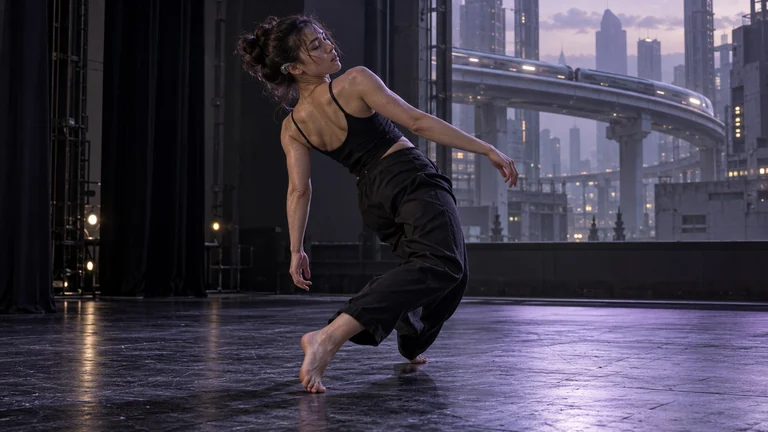
The final show of the season was booked for the opening of the city's new magnetic transport loop. Senn had asked about the field profile. The old loop provided a strong local orientation throughout the theater district. The new one would reverse its principal direction and introduce a pulsing component.
Her producer said the commissioning engineers would keep the public field stable during the show.
The engineers said they had promised it would remain within the safety limit for ordinary visitors.
Those statements met for the first time six minutes into her performance.
Senn was in the long backward passage, eyes closed. She had followed the field into that passage every night for eleven weeks. It gave her a direction independent of what the audience could see, a way of moving toward something while appearing to withdraw.
The direction turned through her.
Her feet remained on the floor. Gravity had not changed. What changed was the bodily certainty that the gesture had an end she could reach. She opened her eyes against a surge of nausea and saw the painted exit light where it had always been.
The music continued.
She managed three more steps by watching the edge of the stage. They were the correct steps. Anybody could have copied them from a recording. They felt empty enough to make her afraid.
In the wings, the producer held up two fingers: keep going.
Senn stopped.
The musicians completed the phrase without her and fell quiet. A cough traveled across the auditorium. She could hear the new loop pulsing through the implant, although hearing was only the nearest word. It was closer to having a direction open and close inside her face.
"I need a moment," she said.
From the cheaper seats at the side, a man called, "The field's turned."
Somebody told him to be quiet. He stood anyway. He was wearing a formal jacket over the stiff collar of an old shaft crew. Two people beside him were rubbing the same place above their noses.
Senn waited for the next pulse. She let it draw her shoulder, then took a short lateral step before it faded. The movement was ugly. Her trailing foot caught in the costume. She lifted the hem and tried again.
The man in the side seats shifted his weight with her. He was finding it too.
She made a sequence out of four pulses, short enough to repeat without pretending she understood the whole field. A musician tentatively joined her. Senn shook her head; the added rhythm made her reach for the old timing. He lowered his instrument.
Some patrons left. Others watched more closely than they had during the polished first six minutes. Senn could not tell whether this was interest or the particular attention people give a public failure. She worked until the nausea eased, then left the stage without completing the advertised final turn.
The producer met her with the touring contract open.
"They need the piece they bought."
The proposed tour would reproduce the old field using a portable generator. She had approved the technical design. It could make the performance repeatable in twenty cities, each with the same invisible direction for her to follow.
For a moment she wanted it fiercely. A direction that would not change, a movement she could finish, a room in which nobody had to watch her learn.
"I could do it," she said.
"Of course you can."
"I don't want to keep calling it this place."
He looked at her for a long time. Then he asked whether she was refusing the tour. She said yes before she could offer a compromise she would resent him for accepting.
Outside, the former shaft workers waited by the theater wall. The man who had called out introduced himself as Paz. He said his crew had spent the afternoon dropping tools on the test sections because the new field kept spoiling familiar reaches. The safety briefing had mentioned no effect on humans.
Senn laughed, and this time it helped.
They walked to the sheltered tram stop, where the field changed again beside a buried junction. Paz took her arm when she stumbled. She helped him past a place where the pulse strengthened too quickly for him to interpret.
Under the shelter, she tried a turn that used the junction's changing direction. Paz stayed still and watched. She tried it more slowly, with the coat open so she could feel where the movement failed.
The theater emptied behind them. Nobody brought a camera. By the time the last tram came, she had made something that would not work on the other side of the street.