Bess could tell there was money inside before she opened it. Paper folded that many times had a particular resistance. She'd spent twenty years counting wages into envelopes for the night shift.
The union secretary had left it on her desk with the ballot-box key.
FOR YOUR TROUBLE.
She counted the notes twice. More than she earned in a month. In the next room, three hundred and seventeen workers were deciding whether to return to the foundry after the accident.
Her husband had been one of the men taken to hospital. He was home now, learning to fasten his shirt with his left hand.
The company said the damaged line was safe. The union wanted an independent inspection. Wages had stopped while they argued.
At six, Bess and the company observer would count the ballots. Warren, the union secretary, had nominated her because everyone trusted her arithmetic.
She locked the envelope in her drawer and went to find him.
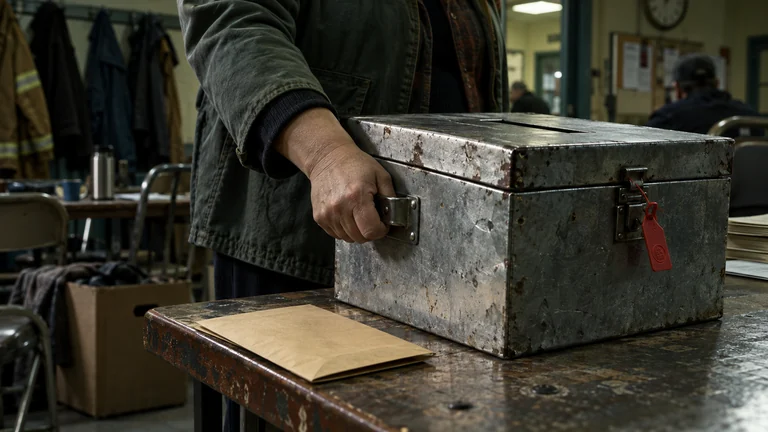
His office was empty. Beneath his desk stood a ballot box with a numbered red seal across the lid.
Bess went back to the voting room and read the seal on its box. Then she returned to Warren's office.
The same number.
Through the second box's slot she could see folded papers, already reaching halfway up its sides. The voting-room box had a dent beneath one handle. This one didn't.
Warren appeared in the doorway.
"Looking for me?"
"I need someone to watch the count."
"The company sends an observer. You know that."
He shifted to let her pass. Behind her, the office door closed.
The clock in the voting room read five forty-seven. A man from the furnace crew was helping his wife fill out the attendance register. She worked beside him, but she couldn't lift her arm above the table since the accident.
Bess asked them to stay afterward. Then she asked the next voter, and the next. She spoke loudly enough for people leaving the room to hear.
"It's your count. You can watch it."
At five fifty-two, Warren came to fetch her for a word in the corridor.
She stayed beside the box.
He bent close enough that nobody else would hear.
"Your husband's compensation hasn't been settled."
Bess looked at the dent beneath the handle. It was in the right place. She kept looking at it until Warren straightened.
When the clock reached six, the company observer came through the service door carrying a cardboard carton. He put it beneath the table.
"We'll do the count in the office," Warren announced. "There's more privacy."
Several workers began collecting their coats.
"Leave the box here," Bess said.
"We're moving ten yards. You can carry it yourself."
That was almost persuasive. She could watch every step, except the moment someone asked her to fetch a chair or answer a question or turn toward a voice.
The observer unfastened the straps securing the box to the table. Bess put her hand through the handle above the dent and sat down.
"I'll count it here."
Warren said her name. She had worked beside him for nine years. He'd brought flowers when her husband came home from hospital.
"There's a second box," she told the room. "Same seal number. It's in that carton."
The observer nudged the carton behind his leg.
Nobody spoke. Bess could hear the small clock above the register, a sound usually lost beneath conversation.
Warren pointed at her.
"Ask her what's in her desk."
The man from the furnace crew looked at Bess.
"Money," she said. "Warren left it there. I counted it. I haven't spent it."
"You accepted it," Warren said.
Her mouth had gone dry. She could still stop, let them carry the box away, let the room believe she'd misunderstood something.
"Open both," she said. "And get the envelope."
The injured woman pulled a chair to the table. Her husband lifted the carton before the observer could reach it. Under the cardboard was a sealed box without a dent.
Two identical numbers. Two full boxes for one vote.
Warren said there would have to be an investigation. Bess agreed. He said the count must wait. The woman beside her took out a pencil.
"We've waited six weeks."
They counted in front of the workers who'd stayed. Another pair counted again. The undented box approved the return almost unanimously. The one Bess had watched all afternoon contained a hundred and sixty-seven votes against, a hundred and fifty in favor.
She wrote both results on the board. Nobody cheered.
The workers signed the record and kept the boxes together until an investigator came for them. Bess surrendered the key to her drawer too. Warren walked out through the service door without his coat.
Two weeks later the line remained closed. The independent inspector hadn't cleared it. There was no fund to replace the missing wages.
Bess collected food parcels beside people whose votes she'd counted. Some thanked her. One man wouldn't look at her. She'd been suspended while the company investigated the envelope, and her own pay packet was empty that Friday.
At home, her husband pinned a piece of bread against the plate with his damaged hand while she sorted the bills.
"How much did they offer?"
She told him.
He looked at the bill for his next therapy appointment. It was already overdue. After a while he asked her to put the cheapest bill on top, so they could pay at least one.