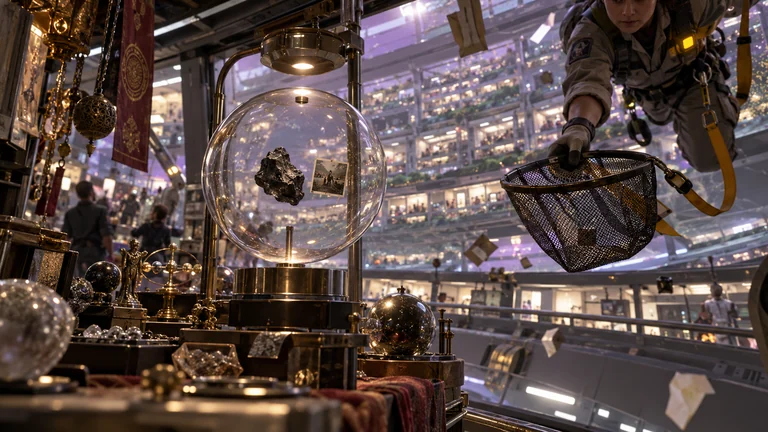
At the axial market, things fell slowly enough for people to become offended when they were asked to pick them up. Umi collected receipts, peelings and small floating displays in a mesh basket. Customers treated the basket as an invitation to let go of whatever they had finished using.
The inhabited rim curved around the market, far beyond the windows. From here it looked like a wall of distant rooms. Out there, people had full weight. Here, near the axis, a dropped cup could travel across a stall before reaching a surface.
The yellow warnings had been lit all morning. The habitat was changing its rotation slightly to accommodate a redistributed water load. During adjustment, the automatic capture currents around the market would run outside their usual pattern. Loose items had to be tethered. Umi had been handing out straps since the first warning.
The man at the antique stall declined one. His object was smaller than his fist and worth, he told her, more than a month's market revenue.
"Then use the strap," she said.
He closed his hand around it instead.
It was a chunk of metal from the habitat's original construction, sealed in a clear sphere. His family had bought a founding share using the proceeds of their groundside house. The fragment commemorated the transfer. There was a photograph of the house inside the casing, positioned so the metal seemed to rest on its roof.
Umi could understand wanting to hold it. She liked objects that were heavy for their size; so much of her working day involved material designed to weigh almost nothing.
The adjustment began while he was turning the sphere to show the dealer the photograph. He reached according to the movement his hand expected. The sphere passed between his fingers, struck the counter and continued toward the service aperture behind the stalls.
He pushed off after it.
Umi caught his jacket before he followed it through.
Beyond the aperture, a radial cargo channel ran toward the rim. Its shutters were open for a maintenance lift. A temporary capture membrane stood ready above the opening. The sphere was still on the market side, drifting through the shallow service recess toward the open shutters.
The movement looked gentle from the market. Umi knew what relative speed it could acquire before reaching the channel's lower end. The greenhouse roof there was built for light, not a dense fragment of old hull inside an ornamental ball.
She called the cargo controller and gave the warning code. The controller stopped the lift and cleared the lower access platform. Then he told her to deploy the membrane before the object passed beyond its reach.
The owner heard him.
"That will crush it."
The membrane could absorb an impact by folding and tightening around the object. It was designed to save the habitat, not preserve the contents of a collector's sphere.
Umi pulled the release.
Nothing came down. One corner had caught on the temporary rail installed for the lift work. She could see the fold held above the sphere's projected path. The controller asked whether she had deployed it.
"It's fouled."
Her refuse net was fixed to the service track by two load-rated clips. It was intended to secure a day's collected rubbish before transport, and stretched farther than the rigid basket she used while working. She released the basket into the net, hooked the free end across the aperture and pulled it open with the track winch.
The controller confirmed the mounting would take the small mass. He told her to stand clear.
The sphere struck through a layer of loose material and drove the mesh into a long cone. The clips held. The clear casing broke, and glittering fragments lodged among peelings and a day's worth of packaging.
The owner made a noise as if she had struck him.
Umi kept the winch locked until the movement ceased. The controller confirmed the lower channel was clear and arranged collection of the damaged net. Then he asked how long the market access would be obstructed.
She looked at what had been sorted, compressed and ready to leave ten minutes earlier.
"A while."
The owner told her he could have paid for a specialist retrieval. She asked whether the specialist could have arrived before his object reached the lower opening. He said that was not the point. Then he apologized, though he did not say what for.
The original metal fragment was recoverable. The little photograph had torn into several pieces, some still trapped inside the casing. A reproduction service could print another clear sphere. It could not make the scattered material separate itself again.
"I'll cover the net," he said.
Umi took two pairs of gloves from the maintenance drawer. She offered him the larger pair and showed him how to secure his feet at the sorting bench.
For a moment she expected him to leave. Then he set his jacket beside the antique dealer's counter and sat down awkwardly. Umi emptied the first section of damaged mesh into the tray between them.
He picked out a tiny blue piece of the photograph and turned it toward the light. She waited until he had placed it safely aside before showing him which material could still be recycled and which now had to be separated by hand.