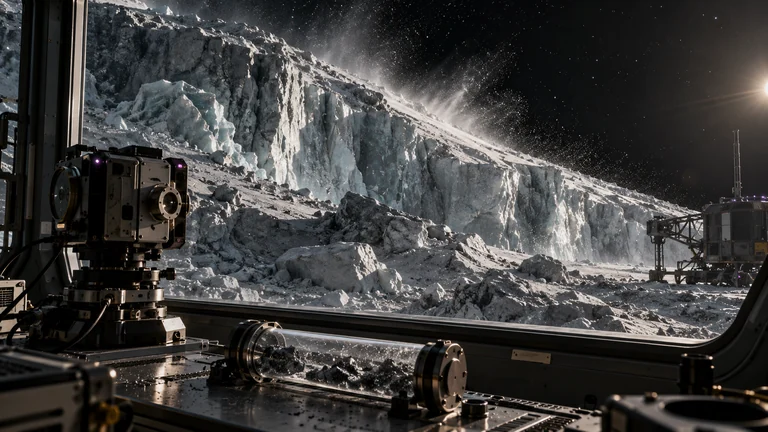
The third time Mair measured the plume, it was gone.
She marked the earlier returns as transient scatter. Above the comet's extraction face, the navigation display settled into a clean field of stars. No particles remained outside the predicted tracks.
Her assistant, Jori, took his hand off the packing crate.
"Can you show me the first pass?"
The carrier would leave in thirty hours. Jori had already strapped his bedding inside his case. They had spent seven months surveying the small body, living beside people who cut water ice for ships with warmer destinations. The survey grant paid for two return berths. The cutters bought theirs with a share of the cargo, at an exchange rate written above the communal kettle.
Mair had booked a room with a bath. Jori had a son who now answered calls himself instead of waiting for someone to lift him toward the camera.
She reopened the first pass.
A pale fan extended from the extraction face. The second pass showed a shorter fan. By the third, the return matched the solid surface beneath it.
"The model converged," she said.
Jori put the images beside the transmitter log. Each fan began after a sounding pulse. Each ended before the next.
Their instrument sent energy into the upper ice and read the scattered return for cracks and voids. Ordinary ranging could show the surface. This told the cutters whether a loaded cradle could pull a slab free without bringing the neighboring face down with it. Mair had designed the repeated passes to distinguish persistent structure from moving debris.
She looked at the dark interval between pulses.
"It could be dust disturbed by the cradle."
"The cradle was parked."
He showed her that log too.
They called Eska, who maintained the collection traps above the face. She arrived with a sample sleeve she had been trying to get somebody to examine since breakfast. Mair remembered telling her to leave it in the receiving rack.
Inside was a little gray powder.
"It wasn't like that when I caught it," Eska said.
Her helmet recording showed branching filaments drifting into the trap, connected in a lattice finer than the sleeve's mesh. They collapsed as she brought them into the warm equipment lock. She had turned off the heater when she noticed, too late to preserve their shape.
Mair had assumed compact ice when calculating how much energy the face could absorb. The filaments had too little mass to take the same pulses without warming. Jori found the cold images Eska took before every shift: threads bridging narrow clefts, their shadows unchanged for weeks before the first sounding.
Now those clefts were empty.
Mair compared the beam footprint with the emptied patches. The boundaries matched. The pulses were warming the threads until some sublimed; escaping vapor carried the remaining lattice into the sky. Repeating the measurement removed more of what disagreed with her model.
Eska watched her move between the images.
"Was any of it useful?"
Mair almost explained the improvement in the survey resolution.
"I don't know what we lost."
There was one unsounded strip beside the next cradle position. Its dark clefts still held threads. The final pass would begin when that face rotated clear of the camp's antenna mast.
Mair paused the sequence.
The cutting supervisor came in carrying a mug with a broken handle. He listened, asked to see the matched boundaries, then called the carrier. Without an internal survey, he would not authorize loading from the remaining strip. The ice already aboard would pay for four cutters' passage. They had planned to send six.
"Can you survey it another way?"
Lower-power pulses, separated by cooling intervals, might leave the structures intact. Mair would have to begin on a small patch and check for damage. Establishing a safe method and covering the strip could take weeks. The carrier's next call was four months away.
The supervisor looked at her open case. She had packed everything except her instruments and the boots beside the door.
"We can leave two people on camp pay. It isn't a death sentence."
"I know."
"You should tell them yourself."
The cutters were drawing lots when she reached the common room. Eska had drawn a short mark. The other belonged to a man who had spent the previous evening making a handle for his daughter's cup. He put his slip beneath the cup and asked whether the camp's next food shipment was confirmed.
Mair told them what the sounding had done. She brought the sleeve, although she could not make the powder look like what Eska had seen.
"Will stopping bring it back?" the man asked.
"No."
Eska laid her slip on the table.
Mair had one berth she could transfer. The carrier confirmed the change before she offered it to Eska. She would remain to develop the slower survey. The man with the cup would remain too. He asked whether she needed the workshop every day, because there were repairs he had postponed for the journey.
She said they would arrange times.
Before Jori boarded, Mair asked him to take the original logs ashore and put his name on the discrepancy report. He read it before agreeing. He changed her phrase inadequate thermal assumptions to assumptions contradicted by retained surface images. She signed below the correction.
The carrier left with the final cradle empty. Eska took the sample sleeve in a cold container; there were laboratories that might learn something from it even now. She did not promise Mair an answer.
That evening Mair reopened the first survey. Beyond the scarred face, particles shone where later images showed clear space. She saved the raw frames beside the finished map and marked the emptied strip as altered during measurement.
In the common room, the cutter had put a second place beside his. His daughter's cup stood wrapped for a journey neither of them would make that season. Mair set down her case, took out the shoes she had packed for home, and put them beneath the spare bunk.