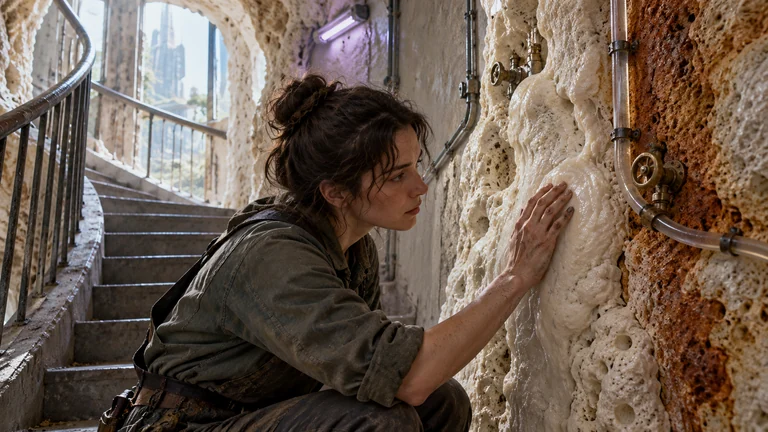
Gale knew the building by its stains. The rust-colored one above the third-floor landing meant the upper culture needed iron. A pale branching mark beside the lift appeared whenever somebody used the wrong cleaner. The green patch near her bedroom window was harmless, although it offended almost everyone who visited.
The block had been grown from mineral foam thirty years earlier. Its maintenance organisms traveled through fine wet channels, depositing material where load sensors signaled strain. Gale had learned to feed them after the caretaker died and the residents discovered that his contract did not include a replacement.
People began leaving supplies outside her door. Eventually they began leaving complaints.
The rejuvenation company arrived in white overalls with a culture guaranteed to restore a continuous surface. Their trial panel looked wonderful. Old stains disappeared under fresh mineral growth, and a broken edge rounded itself overnight. The owners approved treatment because four apartments were on the market and buyers kept asking whether the building was diseased.
Gale asked about the expansion joints.
"The new culture recognizes structural discontinuities," the supervisor said.
She pointed to a joint above the stairs. "That one is meant to open."
He photographed it and attached the image to the site file. She took the photograph as an answer because she wanted somebody else to have the responsibility for once.
For two weeks the block grew prettier. The company washed out the old feeding lines and introduced its culture. Thin deposits covered the stains. Hairline cracks vanished. Gale slept through the night without waking to wonder whether she had opened the upper nutrient valve.
Then the first hot afternoon arrived.
At three, the roof door stuck. At four, the stair rail bowed and the landing tilted. A child's ball rolled toward the lift. Gale put her palm against the sealed expansion joint. It was warm and hard, filled with the same smooth material the owners had admired on the trial panel.
She called the supervisor. His company had logged the joint photograph as an existing defect successfully repaired.
Outside, the sun was still on the western wall. The roof wanted to lengthen. The new mineral seams held the moving sections together, transferring the strain into places that had never been built to take it.
Gale asked everyone on the top floor to leave. One owner told her she was frightening the prospective buyers in his kitchen. A moment later the kitchen window cracked from corner to corner, and he helped carry a sleeping neighbor downstairs.
The emergency engineer reached them before dusk. She approved cutting the filled joints and installing temporary braces. It would release the immediate stress, but the new culture would try to seal every cut unless its local feeding channels were isolated. Keeping the building safe would require a different repair system at the joints.
Gale knew where some of the old one lived.
Nobody had treated the disused rainpipe behind the laundry. Its inspection hatch was too narrow for the rejuvenation hose, so the crew had recorded it as disconnected. Gale had kept its small water supply running because shutting it off required dismantling a shelf.
The culture inside was dark and stringy. Under a work lamp its active filaments shifted toward fresh nutrient. Gale took a sample to the engineer and explained how the old joints had healed: a flexible deposit between harder edges, slow enough to remain movable during daily expansion.
They tested it in a tray while the crew cut the roof seams. The building settled with a sound like a heavy chair being dragged overhead. Water from a damaged feeding line fell through the third-floor light fitting. Nobody slept in the upper apartments that night.
By morning the trial culture had formed a thin flexible bridge. It would take days to build sufficient material in the actual joints. Until then the braces and open cuts would have to hold, and the residents would have to keep the new culture out of those channels.
The owners asked the company to pay. The company asked whether the original caretaker's feeding records had been followed precisely. Gale brought out the notebooks she had kept for nine years. Their handwritten pages looked embarrassingly small beside the legal correspondence.
The roof survived. Its joints remained visible as dark lines between the pale new surfaces. Two apartment buyers withdrew. The owner from the cracked kitchen asked whether the lines could be disguised once everything was stable.
"They have to move," Gale said.
"I understand. I mean cosmetically."
She understood too. He would sell his apartment; somebody else would inherit the daily need to tell a deliberate opening from a defect.
At the residents meeting, they asked her to supervise the recovered culture. They offered a gift from the maintenance fund and thanked her for knowing the building so well.
Gale put the notebooks on the table.
"I need two other people to learn it. Paid hours. A rota. Someone who can cover when I leave."
The treasurer asked where she was going.
She had not booked a journey. She had not even chosen one. The question made her angry enough to remain still until the room became uncomfortable.
The treasurer entered the paid hours beside the repair costs. Two owners put their names below Gale's on the rota. The owner of the cracked kitchen took the first notebook home.
On his first shift, Gale heard him stop outside her door. A valve squeaked in the service cupboard, then stopped. She put down her cup and went into the hall.
He was holding the notebook open with his elbow, searching behind the lower pipes. Gale began to point, then rested her hand against her own doorframe. He checked the drawing again. After a while he found the upper valve and looked toward her. She nodded. He turned it too cautiously, stopped, and checked the page before trying again.