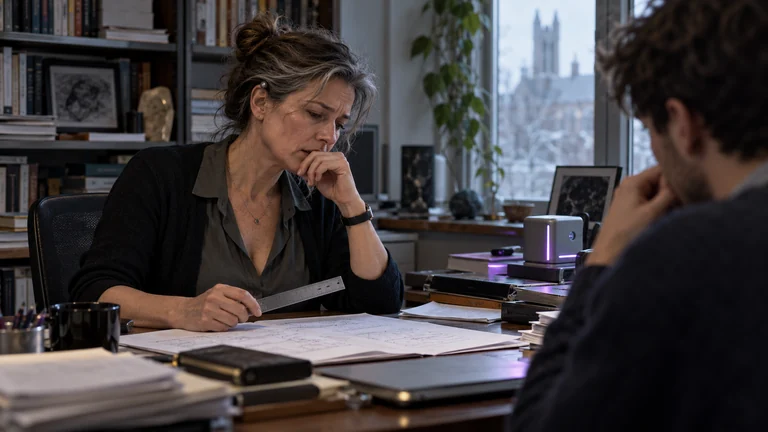
Leonie knew the feeling before she read the proof. A warm pressure gathered beneath her tongue. The edges of the page seemed to move, although when she put a ruler beside them they remained straight.
"Give me a moment," she told the student.
He sat back, pleased. He thought he had made her pause to consider something difficult.
The stability lattice had been implanted three years earlier, after Leonie followed a succession of persuasive claims into six months of bewilderment. For a while she had distrusted the water supply, the faculty mail system and the people who tried to help her. The lattice did not decide what was true. It reinforced the structures she had already chosen to trust and made contradictory associations physically unpleasant until she could assess them with support.
At first that had been a kindness she could scarcely describe. She returned to work. She slept. A confident stranger's argument no longer had the power to rearrange her whole day.
The trouble was that a good new argument arrived by the same route as a bad one.
Her student, Tarin, had found a flaw in the standard account of folded-space packing. It was advanced mathematics, sufficiently abstract that nobody in the room could point to an ordinary object and settle it. He had worked through the familiar assumptions, isolated one that had never been necessary, and constructed a proof without it.
Leonie could follow the first page. On the second, her stomach tightened. By the third she was concentrating on not vomiting in front of him.
"You've worked very hard," she said.
Tarin watched her. He had heard that sentence before.
She asked him to leave the pages and come back the next afternoon. Then she called her colleague Auster, who had declined a lattice because he disliked the thought of anything making certainty easier.
He read the proof at the window. Leonie sat where she could not see the equations reflected in his glasses.
"It works," he said.
She asked him to check the second transformation.
"That's the clever part."
He explained it. The warmth returned beneath her tongue. He stopped when he saw her grip the chair.
"You need someone else to supervise him."
"I can still supervise a student."
"This student. This proof."
Tarin's scholarship came through her department. She had nominated him and secured the laboratory hours he needed. His work would appear under a project she had built over seventeen years. Passing him to Auster would mean telling the board that her carefully restored stability now prevented her from recognizing a discovery.
When Tarin returned, she asked whether he had been sleeping.
He said not much. He had been checking the proof.
"And have you been able to think about anything else?"
He laughed a little. "Not really."
She wrote that down.
There was a support pathway for scholarship students whose work had become distressingly consuming. It provided lattice assessment without charge. Participation was voluntary, but continued funding required a supervisor's certification that the student could work within the agreed program.
Leonie described the pathway accurately. She told Tarin how much it had helped her. She did not tell him that Auster had verified his result.
"You think I'm wrong?" he asked.
"I think you need enough distance to judge it."
He looked down at the pages. She could see how badly he wanted her approval; she had once found that touching. Now it made the conversation easier.
Before he agreed to the assessment, Auster wrote to him directly, confirming the result and offering supervision. The new position had no funding. Tarin showed Leonie the letter; she said a correct result did not settle his readiness to work independently. He kept the scholarship and accepted the assessment.
The clinician asked which cognitive structures the department recommended as stable reference material. Leonie supplied the standard syllabus and the established packing model. The disputed proof remained in a folder marked pending independent review. Auster's note was attached to the folder, but the form had no place for a result that was both verified and difficult for the supervisor to tolerate.
The lattice did not erase Tarin's work. For several weeks he argued with it, leaving sessions pale and furious. Leonie reminded herself that she had resisted support too. She had a true memory available for every misleading comparison she needed.
One afternoon Tarin stopped halfway through explaining the second transformation. He put the chalk down and asked for water.
Leonie brought it herself.
"It's worse when I try to hold both models," he said.
"Then don't force it today."
He nodded, ashamed of needing permission to stop.
The old model returned to the classroom board. Tarin could work within it without discomfort. His progress reports became calmer and more punctual. The scholarship was renewed. Leonie received a note thanking her for the patient handling of a talented student during a difficult period.
The original proof remained pinned beside his desk. One morning he asked whether she would take it down. He remembered writing every line. He remembered why he had thought it mattered. Looking at it made him feel as if he were about to fall.
Leonie removed the pins while he waited in the corridor. She folded the pages with the equations inward, put them in the pending-review folder and closed it.
When she opened the classroom door, Tarin thanked her. The room had become comfortable for both of them.