The customer said he had bought the coat from a man in the market. Rima remembered his hand on the same coat two weeks earlier, tapping the sleeve while he asked whether it could be shortened before Friday.
Before he arrived, she had ordered lunch from the bakery. The owner brought it herself on Thursdays, usually just after twelve, and stayed to eat the other half.
She did not correct him immediately. People forgot things. They bought presents, returned them, lied about money. She had learned to give a customer space to arrive at the account they meant to use.
"The lining's torn," he said. "Just replace that part."
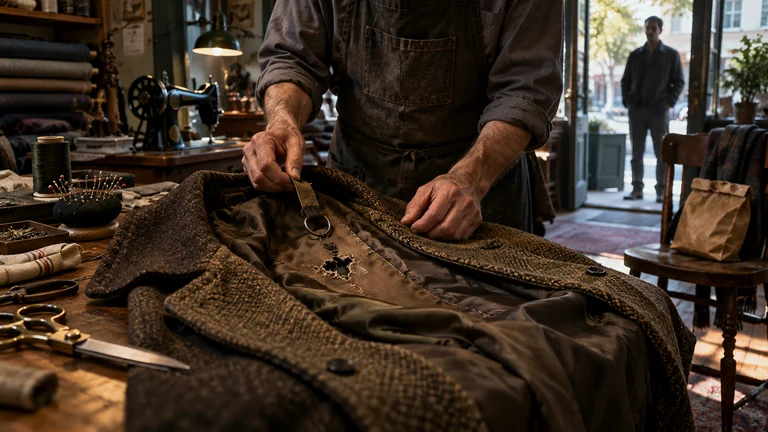
The coat belonged to Anton Greave, whose face had been in the news since Monday. Rima had made a little loop inside it for his house key because his fingers had become too stiff to search deep pockets. The man who brought it for the sleeve alteration had said he was Mr. Greave's driver. Rima remembered the job because she wondered why a driver needed the same coat shortened to his own wrists.
She had asked. He said Mr. Greave was giving it to him.
Now he said he bought it in the market.
"Did you keep a receipt?" she asked.
"For a secondhand coat?"
His smile lasted until he saw her looking at the key loop. It had been pulled away from the lining, leaving a neat row of stitches beside a ragged hole. The key had not been taken out by someone with stiff fingers and time to spare.
"I can remove that as well," Rima said.
"Good."
He stayed while she carried the coat to her worktable. Most people left things and came back. He asked how long. She said she needed to find the right fabric, then opened the order book.
His name was on the earlier page: Kelvin Marsh. He had paid a deposit in cash and signed beside the instruction to shorten both sleeves. The date was Thursday. According to the appeal, Mr. Greave had last been seen leaving his home on Friday, wearing the coat and walking briskly to a car.
Rima looked again at the sleeves she had shortened. They would have been too short for Mr. Greave. They fitted the customer standing beside her exactly.
"I know you," she said.
The words came out before she decided whether to say them.
Kelvin moved to the door and turned the little sign to CLOSED. He did not lock it. That made the gesture feel more deliberate, as though he expected a sign to keep the world away long enough.
"Then you know I pay."
"You said he gave it to you."
"He did."
"But you bought it."
He pulled a chair to the worktable and sat. His knee touched the drawer where she kept her scissors. She left the drawer shut.
"What do you think you saw?"
Rima had seen a man ordering an alteration. She had seen a hand sign a name. She had not seen anyone killed, or even Mr. Greave in the coat after the sleeves were shortened. She described only the first two things. Kelvin listened with the weary expression of somebody being asked to pay twice.
"He wanted to disappear," he said.
It could have been true. That was the difficulty. The photograph showed a man with no one beside him. The reports described property and business interests in more detail than friends.
Kelvin reached for the order book. Rima kept her hand flat on it.
"That has other people's addresses."
"I only want the page."
Through the window she saw the baker approaching with their lunch. Rima did not wave or shout. She moved the order book toward Kelvin, making him turn away from the window to follow it.
The baker opened the door despite the sign. She knew Rima was often late changing it. Kelvin stood too quickly, pushing the chair against the table. He took the coat and left without the book.
Rima asked the baker to stay while she made a call. She gave the investigator the alteration dates, the signed name and the difference in sleeve length. The apparent Friday departure mattered: search teams had been looking for a living man who might have traveled. Rima could say why that sighting needed to be checked again. She could not say where Mr. Greave was.
They found his body three days later, his wrists bound, in the locked garage of a rental property he owned. Kelvin had been using the car while collecting payments from tenants who thought their landlord was away. The coat, hat and borrowed confidence had been enough to make a distant neighbor wave to the wrong man.
An investigator returned for Rima's formal account. She brought a photograph of the recovered coat, asking whether the alterations matched. Rima recognized every stitch and said so.
Afterward she looked at the unused strip of lining on her worktable. She had cut it before Kelvin arrived, for another customer's ordinary repair. For the rest of the afternoon she made herself check the names on each job before putting her hands to the cloth.