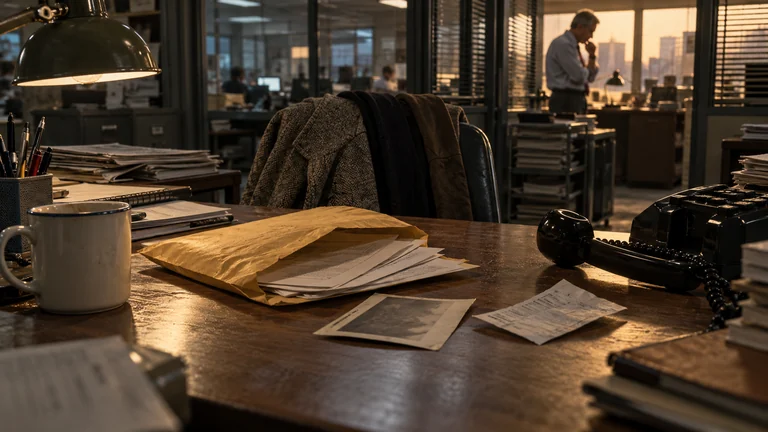
The confession arrived in a padded envelope because the writer thought that would make it safer. Inside were six pages, a photograph and the receipt for a vehicle I had mentioned only once in four years of reporting. The date on the receipt was wrong for the prosecution's account and right for the account the prisoner kept giving.
I read it before taking off my coat.
The writer was dying. He had no useful reason to protect himself, which did not automatically make him truthful. I phoned him. I asked about a detail the police had withheld from the papers. He answered, corrected himself, then described something beside it that I had never understood until that moment.
My editor came over while I was still holding the phone.
"How good?"
"Good."
The man in prison was called Rowan. His conviction had made my career. I had not invented evidence or paid witnesses. I had arranged what I was given into a story so persuasive that people still referred to its headline when they meant his name.
His lawyer had been calling since breakfast. Rowan was being transferred that afternoon to a facility holding a man whose prosecution he had assisted years earlier. Threats had been passed to him. The lawyer was trying to delay the move and had heard that somebody from the original case had contacted us.
"Send whatever you have," she said when I answered. "It doesn't need to be a finished article."
I told her I was checking something. That was true. I was also watching my editor signal for me to end the call.
A rival paper had a statement from the same man's sister. They did not have the confession or the receipt. Our package would have both, plus the original investigation, plus my account of how the evidence had been missed. If we gave the documents out before publication, we could not control who else saw them.
"An hour," my editor said. "Let's get it right."
I had spent four years saying the story mattered enough to get right. The familiar words made the delay feel responsible.
We photographed the pages. We checked names. I called the dying man again and asked whether he consented to publication of the picture. The lawyer called twice while he described where it had been taken. I silenced the second call because it was making his voice hard to hear.
At two, she sent a message saying the transport had not yet left. She needed the documents to support an urgent request for reconsideration and protection. She could not promise the request would succeed. I remember noticing that qualification and using it.
The designer asked which image should lead.
I chose the receipt. It had the authority of something no one had originally intended as evidence. The confession might still be dismissed as a dying man's confusion. The receipt was ordinary enough to make the accusation against us feel difficult to evade.
We argued about the headline. The first version sounded as though we were claiming the conviction had been overturned. It hadn't. I changed it. Then I rewrote the paragraph explaining the appeal process, because I did not want to make another promise that was not ours to give.
At three sixteen, the article went live.
I sent the files to the lawyer at three seventeen. The computer recorded both times with an exactness I would later find obscene, although I had chosen them myself.
The transport had left. The lawyer called the receiving facility, sent the threats again and made the applications she had been preparing all day. She did everything she could after receiving what I had kept until three seventeen.
Rowan was attacked that night. He died two days later. There were inquiries into the transfer, the threats, the placement decision and how long it took staff to reach him. None of those inquiries required my delay in order to find something wrong. That fact was offered to me as comfort by people who wanted me to continue working.
The lawyer did not say I had killed him. She asked when the envelope arrived.
"That morning."
"When that morning?"
I gave the time. Then she asked when I first knew the receipt matched his account, and I found I could remember that just as accurately. I did not need the computer for either answer.
The article won an award the following spring. My editor told me accepting would keep attention on the case. Rowan's sister attended because she had been told there would be a chance to discuss the unfinished inquiry. The presenter asked her to stand while he described our determination to bring the truth to light.
She remained seated.
On my way to the lectern I unfolded the speech we had prepared. The first sentence said we could not afford to wait. I folded that part under, making a crease through the words, and began with the names of the people I was supposed to thank. Rowan's sister watched me from the table. The folded paper kept trying to open against my hand while I read.