Perrin kept increasing the amount. Jago had not asked for money at all.
"A hundred thousand," Perrin said. "They can arrange that."
Jago set the telephone farther away. He wanted the original agreement, the one they signed when the company consisted of two desks and a borrowed heater. His copy lacked the handwritten page assigning him a share of any sale. Perrin had called that page a fabrication when the lawyers asked about it.
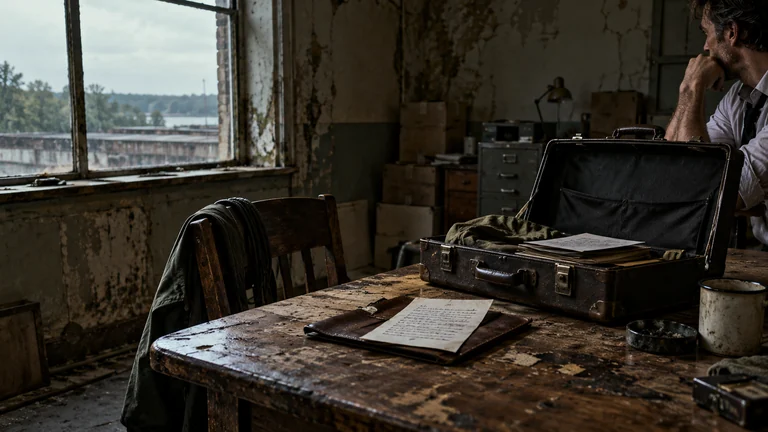
Now the company was sold, and Perrin was tied to a chair in the old dispatch building. Jago had frightened him into coming here with the promise of something worse if he refused. He had been surprised by how little resistance it required.
"You brought the case," Jago said. "Open it."
"The money would be easier."
"The page."
Perrin looked toward the door. It was locked, but the window beside it was wide enough for a man, and Jago had never been good at tying things. The cord around his left wrist had slackened. Perrin did not pull it free.
He recognized the building's smell, cardboard and old roof leaks. They had begun here. Jago had built the first machines in the back room while Perrin found people willing to buy them. At some point the story Perrin told investors stopped including the back room. Jago became an employee, then a former employee, then a person the lawyers advised him not to contact directly.
This morning Jago had contacted him. The timing was extraordinary. The final review of the acquisition accounts began tomorrow. Perrin had been awake for most of three nights, considering explanations that required other people to remember things differently.
He moved his wrist enough to feel the cord burn.
"Call the finance director," he said. "Tell her you want cash."
Jago picked up the case. Its combination was still the month and year they founded the company. He opened it without asking. Perrin watched his face change at that small, surviving piece of trust.
There was no agreement in the main compartment, only an empty company envelope and a narrow plastic wallet full of paper strips. Jago ran his hand around the case before putting it down. A folded bank receipt had slipped through a split in the lining.
Jago emptied the wallet onto the desk.
His signature lay in three pieces. He recognized the blue ink, the downward stroke through the line because they had signed while standing. A fragment of the handwritten page carried the word equally. Perrin had brought what remained, perhaps thinking it would settle the demand faster than another denial.
"You cut it up."
Perrin said nothing.
Jago tried to fit two strips together. There were pieces missing. He could not tell how many. He had spent a year being told to produce an original, and the original had arrived as something that could be swept off a desk.
"Two hundred," Perrin said. "An amount you can carry."
Jago looked at the bank receipt. It recorded a cash deposit made into an account whose number he knew: Perrin had once used it to reimburse their travel. The date was six weeks earlier, before the company sale. The empty envelope beneath it bore a different label: EMERGENCY CASH RESERVE.
The receipt and the figure written on the envelope matched.
Perrin's phone rang. The finance director's name appeared. He leaned toward it as far as the chair allowed.
"Answer."
Jago did. Before he could speak, Perrin called out that he had been taken, that the reserve was gone, that they needed to arrange payment before anyone was hurt.
"What reserve?" Jago asked.
Perrin stared at him. The woman on the phone began asking who was there.
"The cash in the case," Perrin said. "Tell her what you took."
Jago looked at the empty envelope. He had taken the case from Perrin when they entered. There had been no money in it. There had been money six weeks ago, enough to explain why Perrin was so willing to remain in this chair tonight.
He ended the call without giving a figure.
"They'll call the police," Perrin said.
"They should."
It was the first useful thing Jago had said since deciding to bring him here. It would not undo the locked door, the threats or the cord. His own solicitor would have to hear about all of it. He gathered the strips carefully, keeping the receipt separate.
Perrin slipped his hand out of the loop. Jago watched him do it.
"You could have done that."
"You still have the key."
Jago unlocked the door and left the key on the desk. Outside, evening traffic moved beyond the yard fence. He could hear the same delivery vans that had once brought their orders, people finishing ordinary work.
Perrin followed him as far as the threshold.
"At least hit me," he said.
Jago put the paper wallet inside his coat. He walked toward his car without touching him. Behind him the door closed. Through the window he saw Perrin return to the chair and sit, leaving the loosened cord draped across his knees while he waited for someone else to arrive.